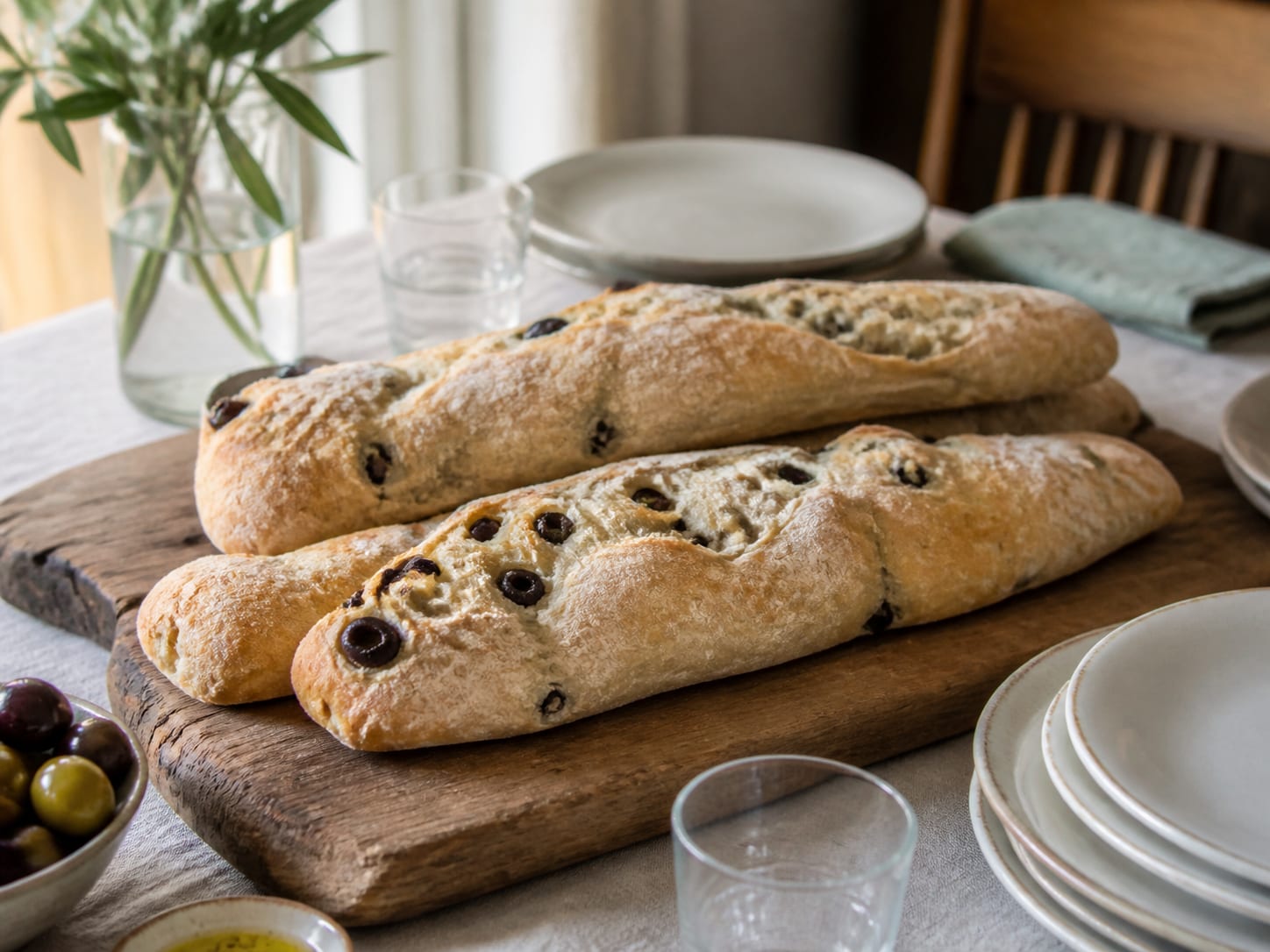
Seelen mit Oliven (Swabian olive rolls)
Swabian Seelen, long, slender rolls with a chewy crust, built on a very wet dough and a long, slow overnight ferment, which is what gives them their characteristic open, irregular crumb rather than a dense, even one. Shaping the wet dough with a dough scraper and floured hands rather than kneading it into a tight shape is what preserves the air structure built up overnight.
Christoph's Seelen with olives, the very wet dough shaped rather than kneaded to preserve the air built up overnight.
Ingredients
Units
Temperature
Servings
Dough
- 500 g flour rounded
- 4 g instant yeast rounded
- 400 ml water, room temperature rounded
- 10 g fine salt rounded
- 100 g pitted olives, roughly chopped rounded
- 15 g coarse salt, for topping rounded
- 10 g caraway seeds, for topping (optional) rounded
Dietary labels are a guide, not a guarantee. If you have an allergy, read the ingredients yourself.
Method
- Combine the flour, yeast and water into a rough, very wet dough. Mix briefly, then cover and let rest for 30 minutes.
- Add the salt and mix in with wet hands, using a stretch-and-fold motion, for 3 to 4 minutes.
- Cover and let rise for 6 to 8 hours at room temperature, or overnight in a cooler spot, folding the dough over itself gently once or twice during the first hour.
- Turn the dough out onto a heavily floured surface. Gently fold in the chopped olives without deflating the dough too much.
- Divide into 8 pieces using a dough scraper, handling gently. Shape each into a long, slender roll by stretching rather than kneading. Transfer to a floured baking sheet.
- Sprinkle with coarse salt and caraway seeds if using. Let rest, covered, for 30 minutes.
- Preheat the oven to 230°C (fan). Bake for 20 to 25 minutes, until the crust is deeply golden and the internal temperature reads at least 96°C.
Notes
- This dough is meant to be very wet, wetter than feels manageable. That high hydration and long, slow ferment are exactly what create the characteristic open, irregular crumb and chewy crust of a proper Seele; a stiffer dough gives a tighter, denser result.
- Shape with a dough scraper and floured hands, not kneading. The goal at this stage is to preserve the air structure built up over the long rise, not develop more structure through vigorous handling.
- Fold the olives in gently. Overworking the dough at this point knocks out the air that took hours to build.
- They’re best eaten the day they’re baked; day-old Seelen are good toasted or used for open-faced sandwiches.
Ingredient substitutions
- This bread doesn’t take well to substitutions in the dough itself; the wet ratio is what defines it.
- Sun-dried tomatoes, chopped, can join or replace the olives.
- A little rosemary folded in with the olives is a nice addition.
From Christoph Mayer