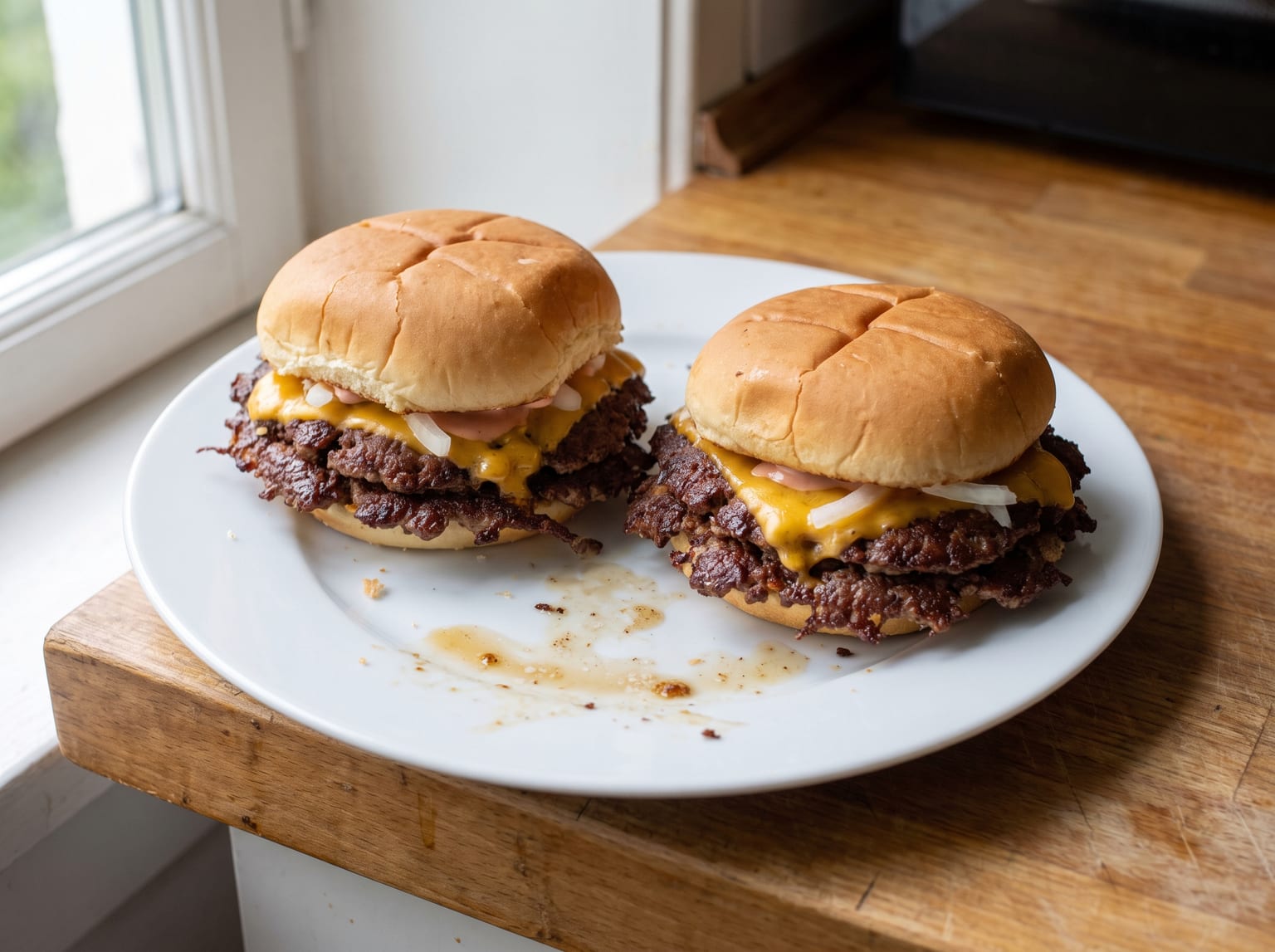
Smash burgers
Eighty gram balls of coarse fatty beef flattened hard onto a ripping hot pan for ten seconds and then left alone, which is the whole technique. Season after the smash, never before, and add the cheese while the patty is still on the heat.
Christoph's own method, written down in his notes
Ingredients
Written for a 30 cm pan
Beef
- 650 g coarsely ground beef, 20 to 25 percent fat, from chuck and brisket, or short rib if you are feeling fancy rounded
- 6 g fine salt, after the smash, never before rounded
- 3 g black pepper, coarsely ground, also after the smash rounded
To build
- 4 soft potato or brioche buns rounded
- 8 slices Irish cheddar, one per patty, on while it is still on the heat rounded
- 2 white onions, one sliced paper thin for the onions, smashed in or fried; one for raw slices rounded
- 30 g butter, for toasting the cut sides of the buns, and for frying the onions if you go that way rounded
- 80 g burger sauce, the house one on this site, or ketchup and mayonnaise rounded
Optional
- 1 large tomato, sliced rounded
- 1 head of lettuce rounded
- to taste pickles rounded
Method
- Divide the beef and do nothing else to it. Roll 8 balls of about 80 g. Do not knead it, do not mix salt through it, do not shape patties. Working the meat makes it springy, and salting it early draws out water and starts curing it into something closer to sausage.
- Get the pan properly hot. Cast iron or a heavy steel griddle over the highest heat you have, until it is ripping hot and a drop of water skitters and vanishes. This is not a pan you preheat for two minutes. An underheated pan steams the beef grey instead of crusting it, and there is no recovering from that.
- Smash, hard, once. Put a ball on the dry pan and press it flat immediately with a stiff spatula or a burger press, using real force, until it is about 5 mm thick and wider than the bun. Hold the press down for a full ten seconds. That contact under pressure is what builds the crust. Then let go and leave it completely alone.
- Season now. Salt and pepper the top of the smashed patty. This is the whole reason the salt was kept back.
- Flip once. After about 2 minutes the underside is a dark crust with lacy frilled edges and the top has turned grey. Scrape it up with a stiff edge so the crust comes with it, flip, and lay a slice of cheddar on straight away. The cheese melts on the residual heat in 30 to 45 seconds and it will not melt properly once the patty leaves the pan.
- Toast the buns cut side down in butter in the same pan, in the fat the beef left behind.
- Build. Sauce on the base, two patties stacked, then raw onion, pickles, lettuce and tomato if you want them, and the lid. Eat immediately. Smash burgers do not wait.
Onions, two ways
Both are worth making and they are not the same burger. Slice the onion as close to paper thin as you can manage either way, a mandoline if you have one.
Smashed in, which is the one to make first
The onion is pressed into the raw beef and cooks as part of the patty. Sweet, steamy, slightly stringy, and the onion ends up caramelised into the crust rather than sitting on top of it. This is the Oklahoma-style onion burger.
- Put the ball of beef down and pile a generous handful of the raw sliced onion on top of it before you smash, then press through the onion so it is driven into the surface of the patty.
- Cover with a lid for the first minute. The trapped steam softens the onion and pulls its juices down into the beef, which is the entire point.
- Lift the lid, let the underside finish crusting, then flip. The onion side now goes down onto the pan and caramelises hard for about 30 seconds while the cheese melts on the other side.
Use more onion than feels sensible. It collapses to a fraction of its raw volume, and a polite scattering disappears entirely.
Fried separately, for a deeper, sweeter onion
The onion is cooked down on its own first and piled on at the end. Darker, jammier and less watery, and because it never touches the raw beef it does not interfere with the crust. This is the diner route.
- Cook the onions before the burgers, not during. A knob of butter over medium heat, a good pinch of salt, and 10 to 12 minutes with the occasional stir until soft, slumped and properly browned. Rushing them on high heat gives you scorched edges and raw middles. Scrape them out and set aside.
- Wipe the pan out and get it ripping hot again for the patties. Cooked onion left in the pan burns to carbon at smashing heat.
- Pile the onions onto the patty at the same moment the cheese goes on, so the cheese melts over and holds them in place.
Which to choose. Smashed in if you want the onion to be part of the burger, fried if you want it to be a topping. Doing both at once is a lot, and the two sweetnesses blur into each other rather than adding up.
Notes
- The beef is the recipe. 20 to 25 percent fat, coarsely ground, chuck and brisket. Lean supermarket mince at 5 percent will not crust, will not taste of much, and will be dry no matter what you do. Short rib is the luxury version.
- Coarse grind matters as much as the fat. Finely minced beef packs dense and turns rubbery under a hard press. A coarse grind keeps the ragged open edges that go lacy and crisp, which is the texture people are actually after.
- Two patties, not one thick one. A double gives you twice the crust for the same weight of beef. That is the whole argument for smashing.
- Do not crowd the pan. Two patties at a time in a 30 cm skillet, three at the very most. Any more and the pan temperature falls off a cliff and you are back to steaming. Cook in waves and hold the finished ones under foil for the few minutes it takes.
- Scale carefully. This is a pan-limited recipe. Doubling the beef does not mean a bigger pan, it means more waves.
Ingredient substitutions
- Buying the beef in Germany. Supermarket Hackfleisch is usually too lean and too finely ground. Ask the butcher, and this is the wording that works:
Ich hätte gerne Rinderhack für Smashburger, bitte frisch gewolft, mit ungefähr 20 bis 25 Prozent Fettanteil. Nicht zu mager. Am besten aus Rindernacken und Rinderbrust. Können Sie es bitte grob wolfen, nicht zu fein?
- The cheese. Irish cheddar is what Christoph uses and it melts well without splitting. A mild orange cheddar or American-style processed slices melt more smoothly still; a sharp aged cheddar tends to break into oil.
- The buns. Soft is the requirement. A crusty roll fights the patty and pushes everything out of the back. Potato buns are best, brioche second.
Sources consulted
The recipe itself is Christoph’s own, written down in his notes rather than adapted from anywhere. The one external check is the safe internal temperature for ground beef.
Good with
Recovered from Christoph's Apple Notes, where it had sat as text since before this site existed. The photograph saved alongside it in that note is not his and is not used here.
From Christoph Mayer