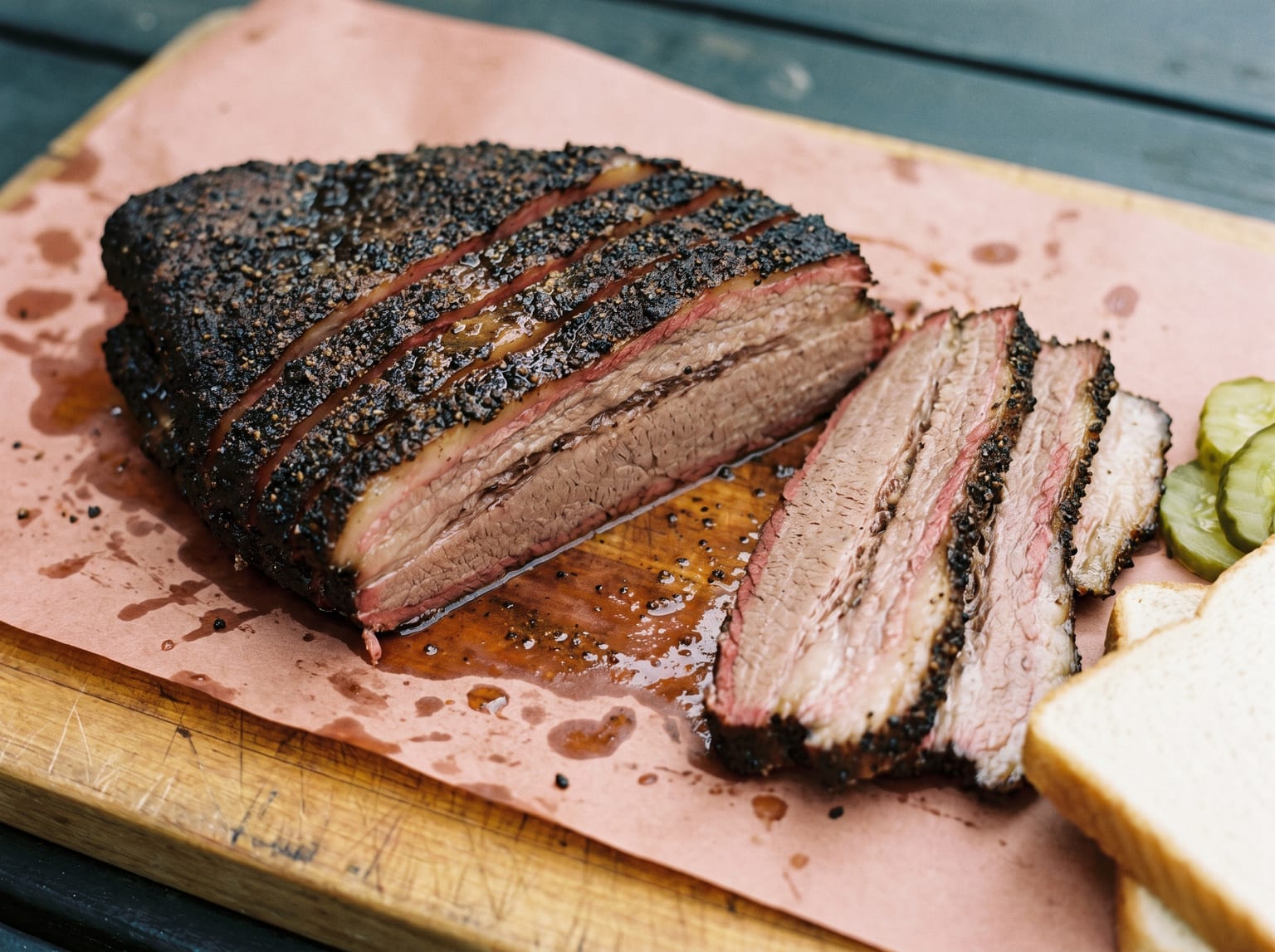
Smoked brisket
A whole packer brisket cooked the Goldee's way, which means a pepper-heavy rub, post oak, a wrap in butcher paper with tallow, and a long hold afterwards that matters as much as the cook. Fourteen hours of cooking and a rest that can run twice as long.
Adapted from the method Goldee's Bar-B-Q in Austin have described publicly, scaled to one brisket in a home offset
Ingredients
Units
Temperature
Servings
Beef
- 6 kg whole packer brisket, point and flat still joined, with a good fat cap; ask for USDA Choice or better rounded
Rub
- 60 g coarse black pepper, 16 mesh, and this is the dominant ingredient rounded
- 45 g kosher salt rounded
- 20 g seasoned salt, Lawry's is what Goldee's use; leave it out and add 5 g more kosher salt rounded
Cook and wrap
- 150 g beef tallow, for the wrap; render the trimmings and you will have more than enough rounded
- to taste post oak or white oak splits, seasoned, not green, and never softwood rounded
- to taste water for spritzing rounded
Dietary labels are a guide, not a guarantee. If you have an allergy, read the ingredients yourself.
Method
- Trim cold. Straight from the fridge, because warm fat smears and tears. Take the fat cap down to about 6 mm, square off the thin edges of the flat so nothing burns, and remove the hard lump of fat between point and flat. Keep every trimming.
- Render the trimmings into tallow. Low heat, an hour or two, strained. This is what goes into the wrap later, and it costs nothing because you already paid for it.
- Rub, pepper first. Mix the pepper, kosher salt and seasoned salt. Coat every surface heavily and evenly. This is a pepper rub with salt in it, not the other way round, and there is no sugar because sugar burns over fourteen hours. Let it sit at room temperature while the fire settles.
- Get the fire right before the meat goes on. Post oak, burning clean. You want thin blue smoke you can barely see. White billowing smoke is a smouldering fire and it will make the brisket taste acrid and bitter. Settle the cooker at 135°C.
- Fat cap down, point end toward the firebox. Cook for about 6 hours untouched. Once the bark has set and will not smudge under a finger, spritz with water every hour or so, mostly to keep the surface from drying.
- Wrap when the bark is right, not at a number. Usually around 74°C internal, but the bark is the signal: dark, dry and fixed. Lay out two overlapping sheets of unwaxed butcher paper, smear a generous layer of tallow across them, put the brisket down fat side up and wrap it tight.
- Back on until probe tender, another 4 to 6 hours. Start checking at 96°C. The probe must slide into the thickest part of the flat with no resistance anywhere.
- Rest long, and warm. This is not optional and it is where most home cooks lose the plate. Vent the brisket for 20 minutes so it stops climbing, then hold it wrapped at 60 to 65°C for at least 4 hours and ideally 8 to 12, in an oven set as low as it goes or a cooler preheated with hot water. A brisket rested for one hour is noticeably tougher and drier than the same brisket rested for eight.
- Slice to order. Separate the point from the flat along the fat seam. Slice the flat across the grain at pencil thickness, and cube or slice the point thicker. The grain runs differently in the two muscles, which is why they are separated first.
Notes
- The long hold is the Goldee’s signature. Plenty of places cook a good brisket; holding it for hours at just above serving temperature is what makes the difference between good and the queue outside. The collagen keeps softening and the juices redistribute instead of running out onto the board.
- Thin blue smoke, always. If you can smell it strongly from across the garden, it is too much. Brisket takes on smoke for the first several hours and dirty smoke in that window cannot be fixed later.
- Fat side down in an offset, because the heat comes from below and the fat cap is a shield. In a vertical or a kamado, fat side up.
- Butcher paper, not foil. Foil traps steam and softens the bark to mush. Paper breathes enough to keep the crust while still pushing through the stall.
- The stall is real. Somewhere around 70°C the temperature stops climbing for hours as moisture evaporates off the surface. Wrapping ends it. Waiting it out also works and gives a better bark, if you have the time.
- Leftovers. Vacuum-sealed and frozen in slices, reheated in a bath of warm water. Never microwave it.
Ingredient substitutions
- Post oak is the Texas wood and is mild and clean. Oak of any kind works. Hickory is stronger, fruit woods are sweeter and lighter, and mesquite over a cook this long is overpowering.
- A whole packer is the point of the recipe. A flat on its own dries out and gives you none of the fatty point, and if that is all you can get, expect a shorter cook and a less forgiving result.
Sources consulted
Good with
Sources consulted
Christoph cooks brisket this way. The photograph is a generated image rather than one of his own cooks.
From Christoph Mayer