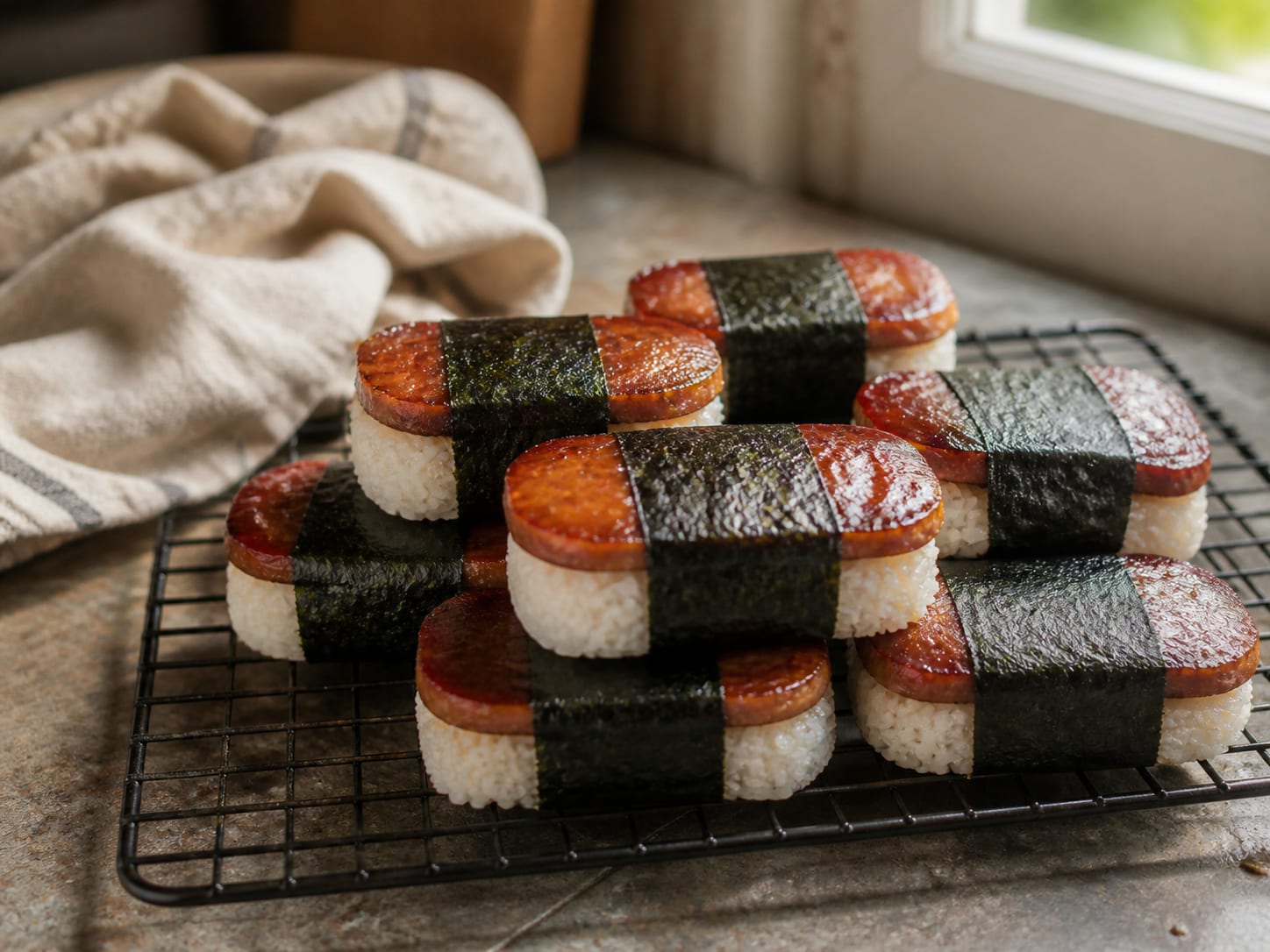
Spam musubi
Pan-fried, shoyu-sugar-glazed Spam set on a block of vinegared sushi rice and wrapped with a strip of nori, Hawaii's favorite grab-and-go snack.
Prep30 min
Cook10 min
Rest10 min
Servings8
Research-based adaptation of common Hawaiian home-style shoyu-sugar glaze ratios and musubi-mold shaping technique, not represented as personally tested.
Ingredients
Written for a 26 cm pan
Units
Temperature
Servings
Seasoned sushi rice
- 380 g short- or medium-grain sushi rice, raw, rinsed until the water runs mostly clear rounded
- 460 ml water, or use your rice cooker's fill line for this quantity of rice rounded
- 30 ml rice vinegar rounded
- 15 g sugar rounded
- 3 g fine salt rounded
Glazed Spam
- 340 g Spam, one standard can, sliced lengthwise into 8 even pieces about 1 cm thick rounded
- 8 g vegetable oil, for the pan; omit if using a well-seasoned nonstick skillet, since Spam releases some fat of its own rounded
- 60 ml shoyu, Japanese soy sauce rounded
- 45 g brown sugar, light or dark brown sugar; granulated sugar also works rounded
- 15 ml mirin, optional, for shine and a rounder sweetness (optional) rounded
Assembly
- 3 nori sheets, cut into thirds lengthwise to make 9 strips; you'll need 8, with one spare for patching a tear rounded
- 16 g furikake, for sprinkling over the rice before topping with the Spam (optional) rounded
Method
- Cook and season the rice. Rinse the rice in a sieve under cold water, swirling and draining until the water runs mostly clear. Cook it with the water in a rice cooker or covered pot until tender, then leave it covered and off the heat for 10 minutes. Meanwhile, warm the rice vinegar, sugar, and salt together just until the sugar dissolves. Turn the hot rice into a wide bowl, pour over the vinegar mixture, and fold it through with a rice paddle or spatula using cutting strokes rather than stirring. Fan or leave uncovered until the rice is warm rather than hot.
- Make the glaze. Whisk the shoyu, brown sugar, and mirin together in a small saucepan until the sugar has mostly dissolved.
- Fry the Spam. Slice the Spam lengthwise into 8 even pieces. Heat the oil in a skillet over medium-high heat and fry the slices until the edges are browned, about 2 minutes per side.
- Glaze the Spam. Lower the heat to medium, pour the glaze over the Spam, and turn each slice to coat both sides. Simmer, turning once or twice, until the glaze reduces to a sticky, clinging lacquer, about 2 to 3 minutes; watch closely, since the sugar can scorch quickly once the glaze thickens.
- Shape each musubi. Lay a nori strip shiny side down on a board and center a musubi mold on top. Without a mold, stand a cleaned Spam can with both ends removed on the nori strip instead, and use a smaller object such as the bottom of a glass to press inside it. Pack in about 100 g of warm rice and press it firm and level with the mold’s press or the back of a spoon. Sprinkle with furikake if using, then top with a glazed Spam slice and press once more to compact the stack.
- Wrap and seal. Lift the mold straight up and off, or slide the can up and off the stack. Fold one long edge of the nori up and over the Spam, then fold the other edge over to overlap it; dab the overlap with a few drops of water to seal it shut.
- Repeat and serve. Repeat with the remaining rice, Spam, and nori. Serve warm or at room temperature the same day, while the nori is still crisp.
Notes
- Spam musubi is best eaten fresh or the same day it’s shaped. Nori wrapped around warm rice softens and turns leathery within a few hours in the refrigerator. If you must make it ahead, keep the rice, glazed Spam, and nori separate and wrap just before eating, or accept the softer texture.
- Spam comes in several sodium levels. The original Classic variety is the saltiest, and its brine already seasons the glazed slice. Spam Lite and the reduced-sodium version are milder, so taste the glaze and add a pinch more shoyu or salt if the finished musubi tastes flat.
- Furikake is optional. It adds a savory, sesame-flecked crunch between the rice and the Spam, but the musubi is complete without it.
- Short- or medium-grain sushi rice is essential for the block to hold its shape; long-grain rice won’t compress the same way.
Ingredient substitutions
- Spam is the traditional ingredient here, and its saltiness and fat content are what the glaze is built around. In Germany, Spam itself isn’t a routine supermarket item; look for it at Asian or international grocers, or order it online. A similar fully cooked canned luncheon meat, such as Frühstücksfleisch, works as a substitute, but it’s more mildly seasoned than Spam, so taste the glaze and add a little more shoyu or salt to compensate. In Canada, Spam is widely available at most major supermarkets, and no substitution is usually needed.
- Nori (dried seaweed sheets) is available in both regions at any Asian grocer or well-stocked supermarket. There’s no real substitute for the wrap, since it’s what gives musubi its handheld shape and flavor.
- Furikake, if you want it, is also available at Asian grocers in both regions; a mix of toasted sesame seeds and a small pinch of salt is a reasonable stand-in.
Sources consulted
- Plays Well With Butter: Best-Ever Spam Musubi
- Hungry Huy: How To Make Spam Musubi
- Smithsonian Folklife Festival: Hawaiian Shoyu Musubi
- The Kitchn: Hawaii-Style Spam Musubi Recipe
Sources consulted
From Christoph Mayer