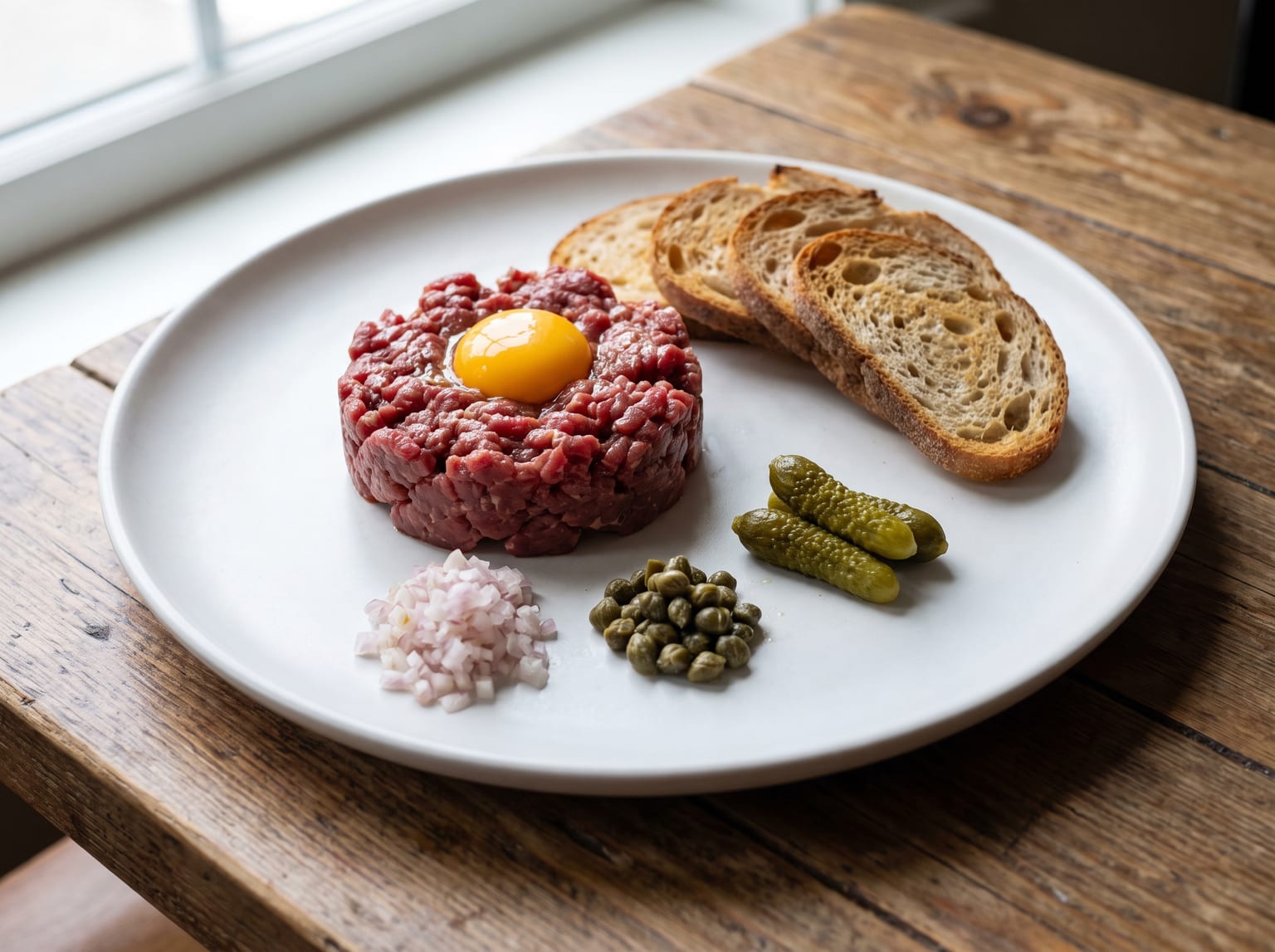
Steak tartare
Raw beef chopped by hand rather than minced, seasoned at the table and eaten immediately. The whole dish is one ingredient, so it stands or falls on the beef you buy and on keeping everything cold.
Prep30 min
0 0 Servings4
Classic French bistro method, chopped by hand and seasoned to order
Ingredients
Units
Temperature
Servings
Beef
- 400 g beef fillet or lean rump, one whole piece, trimmed of all fat and sinew, bought the same day and told to the butcher it is for tartare rounded
Seasoning
- 1 shallot, very finely diced rounded
- 25 g cornichons, finely chopped rounded
- 20 g capers, rinsed and chopped rounded
- 10 g flat-leaf parsley, finely chopped rounded
- 10 g Dijon mustard rounded
- 10 ml Worcestershire sauce rounded
- 15 ml olive oil rounded
- 4 g fine salt, added at the very end, never in advance rounded
- 2 g black pepper rounded
- to taste Tabasco rounded
To serve
- 4 egg yolks, one per plate, very fresh; see the note on raw egg rounded
- 8 thin slices of sourdough, toasted hard, or use chips instead rounded
Dietary labels are a guide, not a guarantee. If you have an allergy, read the ingredients yourself.
Before you start
This is raw beef, and the recipe is mostly about handling it.
- Buy one whole piece of muscle, not anything pre-minced, and buy it the day you eat it. Tell the butcher it is for tartare. Bacteria live on cut surfaces, so a whole piece is safe in a way that mince, with its enormous surface area, is not.
- Keep it cold throughout. Fridge until the moment you chop, chilled bowl, chilled plates, and back to the fridge if anything interrupts you.
- Chop, season and serve in one go. Tartare is not made ahead. Salt starts curing it and the colour and texture go within the hour.
- Raw beef and raw egg are not for everyone. Pregnant women, young children, older people and anyone immunocompromised should not eat this. If the raw yolk is the part that worries you, pasteurised yolks work and are widely sold.
Method
- Chill everything. Beef in the coldest part of the fridge, and put the bowl and the plates in the freezer for 15 minutes. Cold beef cuts cleanly; warm beef smears.
- Trim ruthlessly. Remove every scrap of fat, silverskin and sinew. Fat is unpleasant raw and sinew is simply chewy. Expect to lose some weight off the piece.
- Chop by hand, and do not use a machine. Slice the beef about 4 mm thick, cut the slices into 4 mm strips, then across into 4 mm dice. Work with a sharp heavy knife and keep going until it is even. A mincer crushes and smears the meat, pressing out juice and giving you a paste that eats like wet mince. Hand-chopped tartare has separate pieces you can feel, and that texture is the entire point.
- Season in the bowl, not on the plate. Fold through the shallot, cornichons, capers, parsley, mustard, Worcestershire and oil. Salt and pepper last, then taste and push it further with Tabasco. It should be sharper and saltier than feels sensible, because raw beef is mild and swallows seasoning.
- Plate immediately. Shape a loose mound with a ring or two spoons, press a hollow in the top and slide a yolk in. Toast alongside.
Notes
- The cut. Fillet is traditional, tender and mild. A well-trimmed lean rump has considerably more flavour for a fraction of the money, and it is what most bistros actually use. Avoid anything marbled: those fat seams are lovely cooked and waxy raw.
- Season at the table if you prefer. Plenty of places bring the chopped beef and the garnishes separately and let people build their own, which is a good way to serve it to a table with different tastes.
- Capers and cornichons are structural, not decorative. Raw beef with no acid is heavy after four mouthfuls.
- Leftovers do not exist. Anything not eaten goes in the bin. Do not keep it, and do not cook it the next day.
Ingredient substitutions
- Worcestershire sauce contains anchovy. Soy sauce with a squeeze of lemon gets you to a similar savoury sharpness if that matters.
- Raw egg yolk can be replaced with a pasteurised yolk, or left out entirely and the tartare bound with an extra spoon of oil and mustard.
Sources consulted
- Serious Eats: steak tartare
- German Federal Institute for Risk Assessment: raw meat and raw meat products
Good with
Sources consulted
From Christoph Mayer