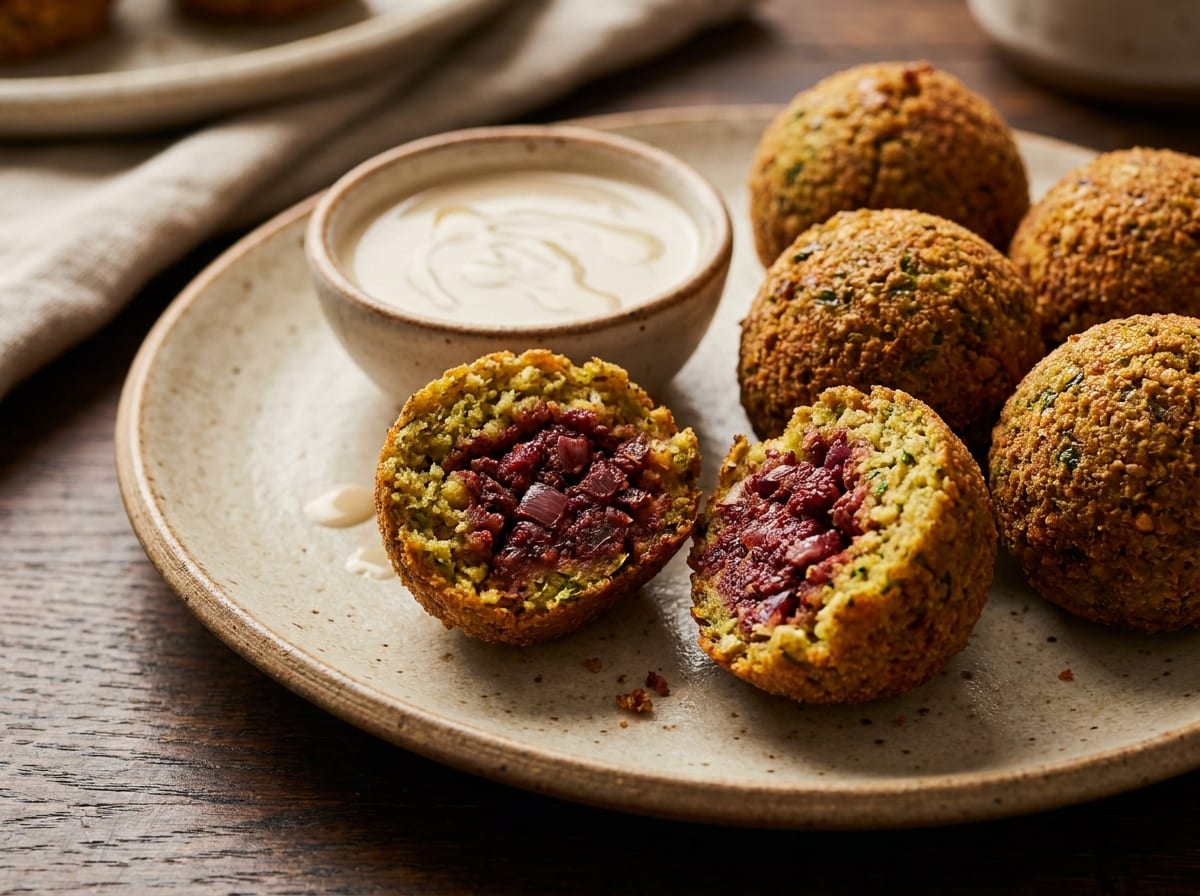
Stuffed Falafel (Falafel Mehshi)
The same chickpea dough as a classic Levantine falafel, but with a sumac-and-onion filling pressed into the centre of each ball before it goes into the oil, so every falafel has a distinct, tangy payoff at the core instead of a uniform crumb all the way through. The stuffing is what makes this its own recipe, the dough itself is not the point here.
Prep50 min
Cook20 min
Rest750 min
Servings6
Falafel mehshi, a classic chickpea dough wrapped around a sumac-onion filling before frying.
Ingredients
Written for a 3 L pot
Units
Temperature
Servings
Falafel dough
- 300 g dried chickpeas, soaked in plenty of cold water for 12 to 24 hours, never cooked or tinned rounded
- 50 g yellow onion, roughly chopped rounded
- 3 garlic cloves rounded
- 35 g fresh flat-leaf parsley, leaves and tender stems, dried thoroughly after washing rounded
- 8 g ground cumin rounded
- 4 g ground coriander rounded
- 10 g fine salt rounded
- 3 g baking soda rounded
Sumac-onion stuffing
- 150 g red onion, very finely chopped rounded
- 10 g ground sumac rounded
- 15 g fresh flat-leaf parsley, finely chopped rounded
- 15 ml olive oil rounded
- 3 g fine salt rounded
- to taste neutral oil, for deep frying rounded
Dietary labels are a guide, not a guarantee. If you have an allergy, read the ingredients yourself.
Method
- Drain the soaked chickpeas very well and spread them on a clean towel to dry.
- Make the stuffing first. Toss the red onion with the sumac, parsley, olive oil and salt. Set aside so the onion softens slightly and releases a little liquid while you make the dough.
- Pulse the chickpeas, onion, garlic, parsley, cumin, coriander and salt in a food processor. Scrape down the sides several times. Stop when the mixture is coarse, damp and holds together when squeezed.
- Cover and refrigerate the dough for at least 30 minutes, up to overnight.
- Fold the baking soda into the dough just before shaping.
- Take a portion of dough, about 30 g, and flatten it in your palm. Press a heaped teaspoon of the sumac-onion stuffing into the centre, then wrap the dough fully around it and roll into a ball, sealing the seam completely; any gap will let the filling escape in the oil.
- Heat the oil to 175 to 190°C in a deep, heavy pot. Fry in small batches, without crowding the pot, for 3 to 4 minutes, turning once, until deep golden brown and crisp all over.
- Lift out with a slotted spoon onto a paper-towel-lined tray. Serve hot, cut in half to show the filling.
Notes
- Seal the seam completely, this is the one step that can’t be rushed. A stuffed falafel with any gap in the dough will leak filling into the hot oil, which both wastes the stuffing and can cause spattering; press and smooth the seam with wet fingertips if it isn’t holding.
- The stuffing is meant to be assertive. Sumac’s sharp, lemony tang is what makes the centre a genuine payoff rather than just more onion; don’t scale it back to taste milder, that defeats the point of stuffing them at all.
- Keep the dough layer thin and even around the filling. A too-thick shell takes longer to cook through and risks the outside over-browning before the stuffing’s flavour comes through; a too-thin shell is what tears.
- These are best eaten the moment they’re cool enough to handle, cut open so the filling is visible; they don’t reheat as cleanly as a plain falafel since the interior moisture from the stuffing softens the crust.
Ingredient substitutions
- A pickled turnip or a few strips of preserved lemon, added to the stuffing alongside the onion, is a common home-cook variation.
- Serve cut open on a plate with tahini sauce spooned into the cut, rather than tucked whole into pita, so the filling stays visible.
Sources consulted
- Remitly: Israeli Falafel, How to Make It and Why It’s Famous
- Palestine In A Dish: Authentic Chickpea Falafel
Good with
Sources consulted
From Christoph Mayer