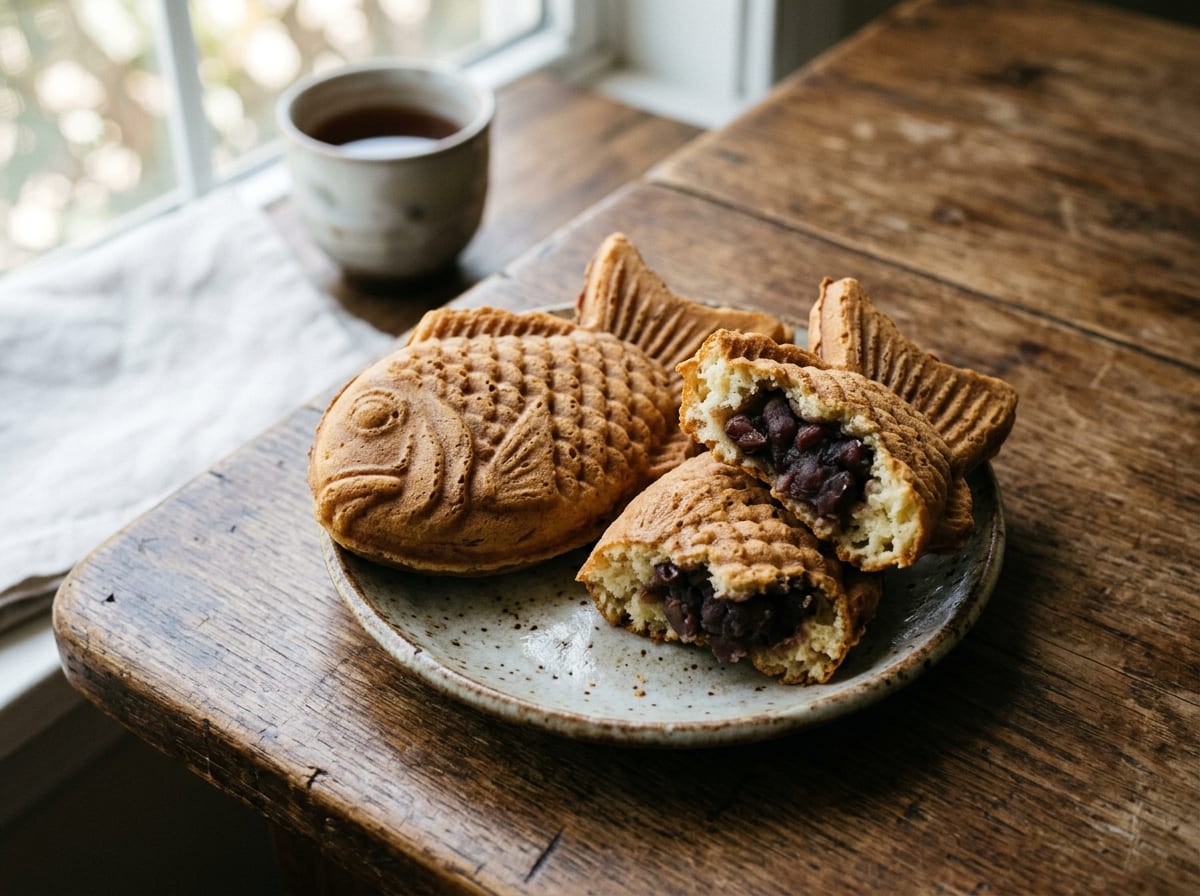
Taiyaki
Fish-shaped waffle cakes with a crisp golden shell and warm sweet red bean paste hidden inside, cooked two at a time in a hinged cast-iron mold on the stovetop. Tokyo's favorite festival snack since 1909, still sold hot off the griddle from street stalls today.
Batter ratios and stovetop technique adapted from Just One Cookbook's taiyaki recipe
Ingredients
Written for a 30 cm pan
Batter
- 140 g cake flour, or all-purpose flour rounded
- 4 g baking powder rounded
- 5 g baking soda rounded
- 38 g sugar rounded
- 1 egg, large, about 50 g rounded
- 180 ml whole milk rounded
Filling
- 160 g sweet red bean paste (anko), smooth koshian or chunky tsubuan, your choice, thawed if frozen rounded
For the pan
- 15 ml neutral oil, for greasing the mold rounded
Dietary labels are a guide, not a guarantee. If you have an allergy, read the ingredients yourself.
Method
- Sift the flour, baking powder, and baking soda into a large bowl. Whisk in the sugar.
- In a separate bowl, whisk the egg, then whisk in the milk until combined.
- Pour the wet ingredients into the dry and whisk until just smooth. A few small lumps are fine, do not overwork the batter.
- Cover and refrigerate the batter for at least 1 hour, up to overnight. This rest relaxes the gluten so the shell turns out tender and crisp instead of tough and chewy.
- Preheat the taiyaki pan over medium-low heat on both sides of the hinge. Brush both mold halves lightly with oil.
- Ladle batter into each fish-shaped cavity until about 60% full. Spoon roughly 1 tablespoon (about 20 g) of anko into the center of each, then top with a little more batter to just cover the filling.
- Close the lid and immediately flip the pan so the top half starts cooking too. Cook for 2 to 2½ minutes, flip back, and cook the other side for another 2 to 2½ minutes, until deep golden brown on both sides.
- Open the mold carefully and lift the taiyaki out with a fork or chopsticks onto a wire rack. Re-oil the mold and repeat with the remaining batter and anko.
- Serve warm. The anko stays hot inside for a few minutes and the shell is at its crispest straight off the pan.
Notes
- Do not skip the batter rest. Gluten that has not relaxed makes a shell that puffs unevenly and turns leathery instead of crisp.
- Fill the mold cavities evenly and do not overfill them, batter that escapes the seam when you close the lid burns onto the hinge and is a pain to scrape off.
- The batter can be mixed the night before and left covered in the fridge, which also makes this a good make-ahead base for a weekend batch.
- Once cool, leftover taiyaki freeze well individually wrapped for up to a month. Reheat from frozen in a dry skillet or a toaster oven until the shell crisps again, a few minutes each side. Skip the microwave, it turns the shell soft and a little rubbery.
- A traditional cast-iron or aluminum taiyaki pan, the hinged mold that gives taiyaki its fish shape, is not something a typical German kitchen shop stocks. It turns up on Amazon.de, at Japanese specialty retailers online, and occasionally in well-stocked Asia-Läden. Without one, a stovetop or electric sandwich press (the kind used for a croque-monsieur) will reproduce the crisp-shell-and-hot-filling technique closely, just in a rectangular shape rather than a fish. A round æbleskiver pan, which some German kitchen shops carry for Danish pancake balls, gets you individually filled rounds that are closer in spirit, though still not fish-shaped.
- Sweet red bean paste (anko) itself is easier to find than the pan, most Asia-Läden in German cities carry it tinned or in tubs, sold as Japanese or Chinese red bean paste. If yours does not, canned azuki beans mashed with sugar over low heat until thick make a reasonable home version.
Sources Consulted
- Just One Cookbook, “Taiyaki”
- Tokyo Weekender, “Taiyaki: The Story Behind Japan’s Beloved Fish-Shaped Snack”
Cup and tablespoon measures from the source were converted to metric grams and millilitres using standard baking conversions. Quantities and yield (8 pieces) were kept close to the original rather than rescaled, since that already lands at the requested serving size. Wording, method phrasing, and the doneness cue are original.
From Christoph Mayer