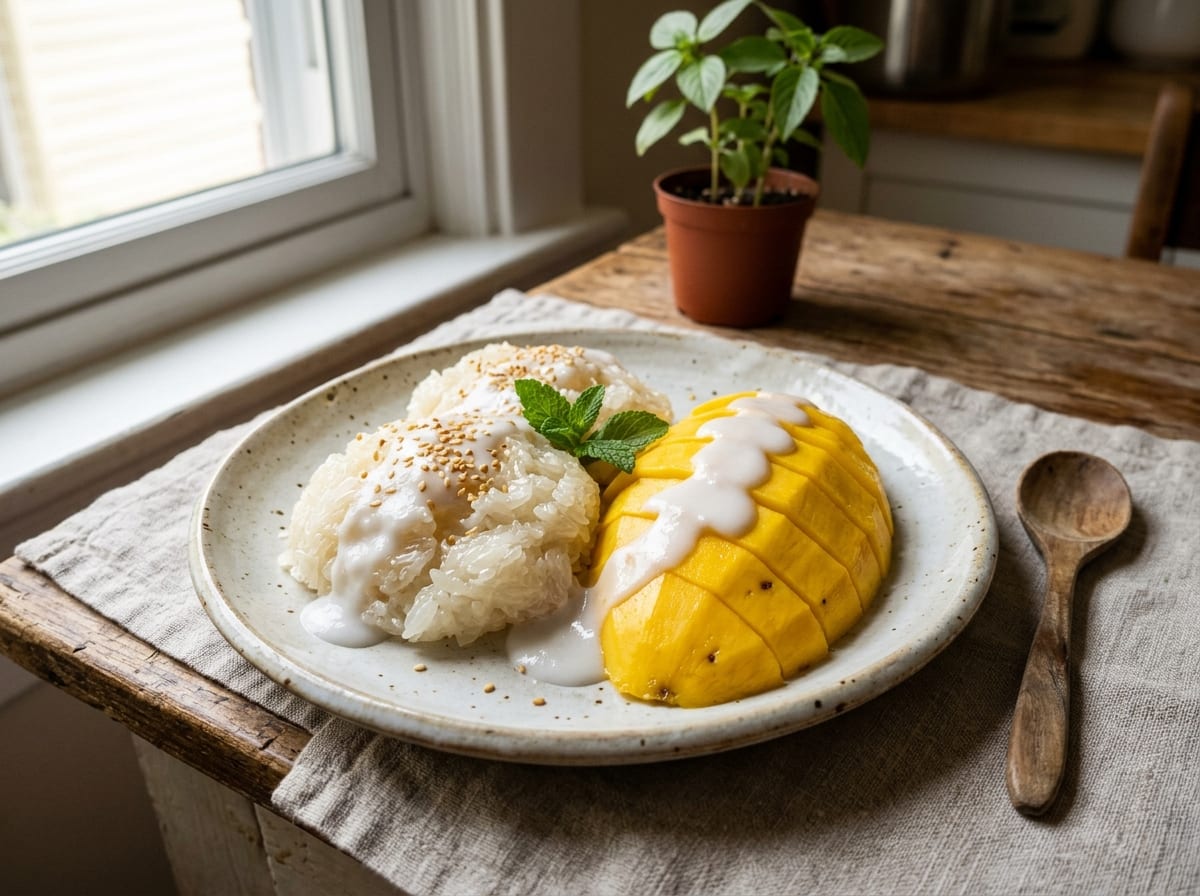
Thai mango sticky rice
Glutinous rice steamed until tender, then soaked warm in sweetened coconut milk until glossy and sticky, served with ripe mango slices, a salted coconut cream drizzle, and toasted mung beans. Thailand's best-known dessert export.
Technique and ratios adapted from Eating Thai Food and Susie's Thai Kitchen methods for khao niew mamuang
Ingredients
Sticky rice
- 300 g Thai glutinous rice (sticky rice), rinsed until the water runs mostly clear, then soaked rounded
- 240 ml full-fat coconut milk rounded
- 50 g granulated sugar rounded
- 3 g fine salt, about 1/2 tsp rounded
Salted coconut cream topping
- 160 ml full-fat coconut milk, the thick part from the top of the can, if the can has separated rounded
- 25 g granulated sugar rounded
- 2 g fine salt, about 1/3 tsp rounded
- 5 g cornstarch rounded
- 15 ml water, to make a slurry with the cornstarch rounded
To serve
- 2 ripe mangoes, peeled and sliced, about 250 g flesh each rounded
- 20 g toasted mung beans or sesame seeds, split, peeled mung beans if you can find them rounded
Dietary labels are a guide, not a guarantee. If you have an allergy, read the ingredients yourself.
Method
- Rinse the glutinous rice in a bowl under cold water, swishing it with your hand and changing the water 5 to 6 times, until it runs mostly clear. Cover with plenty of fresh cold water and soak for at least 4 hours, up to overnight.
- Drain the rice well. If you have a bamboo steamer or a steamer insert, line it with cheesecloth or a thin, wrung-out cotton cloth. Without a proper steamer, set a fine-mesh sieve or colander over a pot holding a few centimetres of water, wide enough that the base of the sieve stays clear of the water, and line the sieve with damp cheesecloth so the grains cannot fall through. Spread the drained rice in an even layer over the cloth, cover loosely with a lid or a foil tent, bring the water to a gentle boil, and steam for 20 to 25 minutes, turning the rice packet over once halfway through, until the grains are tender and translucent with no hard white core.
- While the rice steams, warm the coconut milk, sugar, and salt for the rice in a small saucepan over medium heat, stirring just until the sugar dissolves and the mixture is hot but not boiling. Remove from the heat.
- As soon as the rice is done, tip it into a heatproof bowl and pour the warm coconut milk mixture over it while both are hot. Stir gently to combine; it will look loose and soupy at first. Cover and let rest for 20 minutes so the rice absorbs the liquid and turns glossy and sticky.
- Meanwhile, make the salted coconut cream topping: combine the coconut milk, sugar, and salt in a small saucepan. Stir the cornstarch into the water to make a smooth slurry, then whisk it into the pan. Set over medium-low heat and cook, stirring constantly, for 2 to 3 minutes, until the mixture thickens slightly into a pourable cream. Set aside to cool a little.
- Toast the mung beans or sesame seeds in a dry skillet over medium-low heat, shaking the pan often, for 3 to 4 minutes, until golden and fragrant. Tip them out onto a plate right away so they stop toasting.
- To serve, mound the warm or room-temperature sticky rice on plates alongside the sliced mango. Spoon the salted coconut cream over the rice, and over the mango if you like, then scatter with the toasted mung beans or sesame seeds.
Notes
- Look for a mango that gives slightly under gentle pressure all over, smells sweetly fragrant at the stem end, and feels heavy for its size. Skin colour varies hugely by variety, so smell and give are more reliable than how yellow or red it looks.
- German supermarkets mostly stock Kent and Keitt mangoes shipped from Peru, Brazil, or Ivory Coast, which are fibrous and usually sold hard and underripe. Buy them several days ahead and let them ripen at room temperature on the counter; a paper bag speeds it up. If you come across Ataulfo mangoes, sometimes labelled honey or Manila mango, they are closer in sweetness and texture to the Nam Dok Mai variety traditionally used for this dish in Thailand.
- The salt in both the rice mixture and the topping is not a mistake: the contrast against the sweet rice and ripe mango is what makes the dessert taste balanced rather than cloying.
- The rice keeps absorbing coconut milk as it sits, so it is best served within an hour or two of resting. It turns dense and gummy once fully cold; do not refrigerate leftovers if you can avoid it, and if you must, bring them back to room temperature or gently reheat before serving.
Sources Consulted
- Eating Thai Food, “Thai Mango Sticky Rice Recipe”
- Susie’s Thai Kitchen, “Thai Mango Sticky Rice Recipe (Khao Niaow Ma Muang)”
The soak-then-steam method, the two-part coconut milk (one part folded into the hot rice, a second part cooked down separately into a salted cream for topping), and the toasted mung bean garnish come from the sources. Ingredient list, quantities scaled to four servings, metric conversions, and wording are original.
From Christoph Mayer