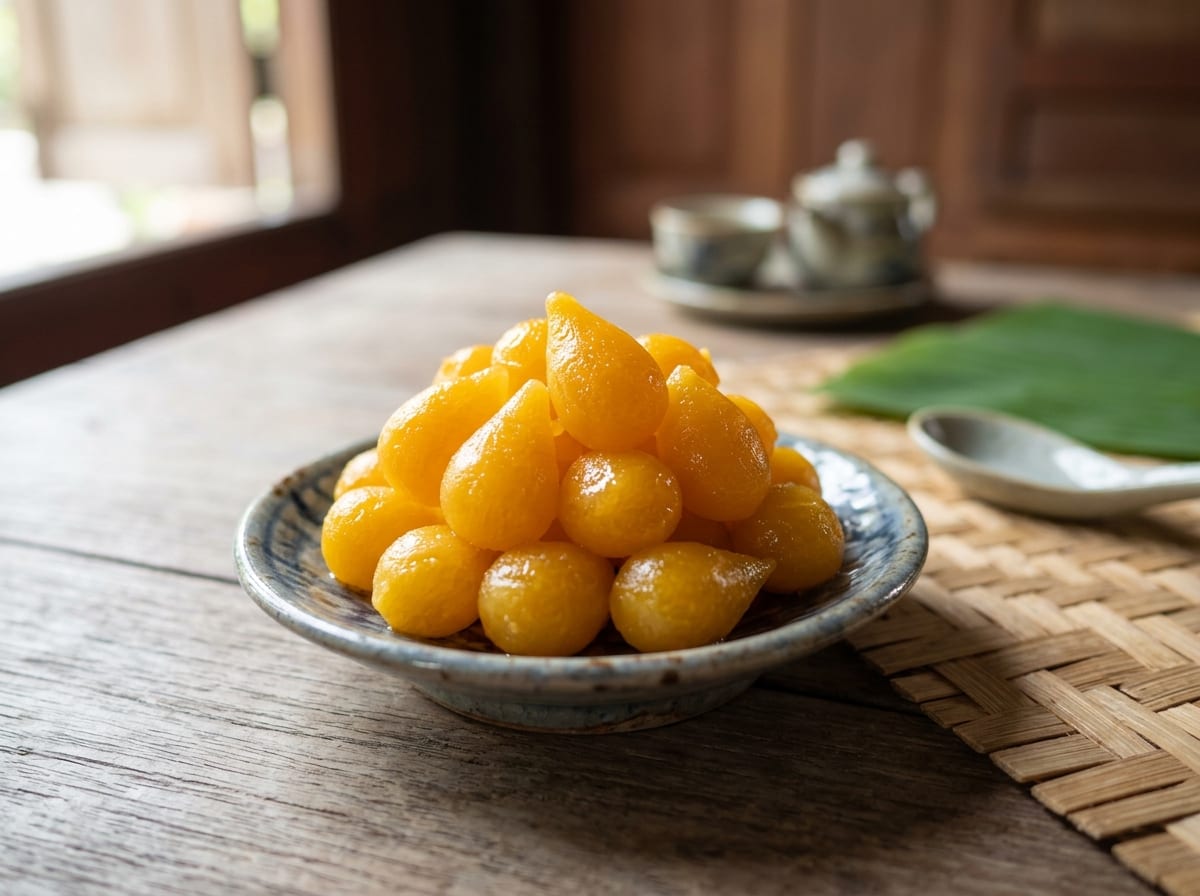
Thong yod (Thai golden egg yolk drops)
One of Thailand's nine auspicious desserts: egg yolks whisked to a ribbon, dropped by the spoonful into simmering jasmine-scented syrup, and set into small, dense, intensely golden teardrops. A wedding and ceremony sweet descended from Portuguese convent egg confections brought to the 17th-century Siamese court.
Technique, syrup method and jasmine-water flavoring adapted from traditional Thai thong yod recipes and a closely related Thai-Portuguese egg-and-syrup reference recipe.
Ingredients
Golden yolk mixture
- 10 large egg yolks, whites reserved for another use, yolks kept free of any white or membrane rounded
- 15 g rice flour, sifted, helps the drops hold their shape; purists skip it and rely on whisking alone (optional) rounded
Cooking syrup
- 300 g granulated sugar rounded
- 240 ml water, jasmine-scented if possible, see Notes rounded
- 2 pandan leaves, tied in a knot; a stand-in for jasmine if you have no jasmine flowers or tea (optional) rounded
Light finishing syrup
- 100 g granulated sugar rounded
- 100 ml water rounded
Dietary labels are a guide, not a guarantee. If you have an allergy, read the ingredients yourself.
Method
- If flavoring the syrup with jasmine, do this the night before: submerge a handful of fresh, pesticide-free jasmine blossoms in the water for the cooking syrup, cover, and refrigerate overnight, then strain out the flowers before use. A jasmine tea bag steeped for a few minutes is a workable stand-in, and the pandan leaves below cover you if you have neither.
- Separate the egg yolks from the whites, keeping the whites for another use. Push the yolks through a fine sieve or a double layer of cheesecloth to strain out the chalazae and any trace of white. This is what gives the finished drops their smooth, unbroken surface.
- Whisk the yolks vigorously, by hand or with electric beaters, for 8 to 10 minutes, until pale, thick, and roughly doubled in volume. The mixture should fall from the whisk in a slow, ribbon-like trail rather than run off it. If using the rice flour, sift it in now and fold gently to combine without deflating the yolks.
- Make the cooking syrup: combine the sugar, water, and pandan leaves (if using) in a wide, heavy pot. Bring to a boil without stirring, swirling the pot instead if the sugar needs help dissolving, then reduce to a gentle simmer, small bubbles breaking steadily at the centre rather than a rolling boil.
- Make the light finishing syrup separately, in a wide bowl or shallow pan: combine its sugar and water, bring to a simmer until the sugar dissolves, then set aside to cool to room temperature. This is where the cooked drops rest and take on their gloss.
- Fit a piping bag with a small plain round tip, about 5 to 6 mm across, or use a mold or funnel with holes of that size. Fill it with the yolk mixture. A teaspoon and a light touch of the fingertip works too, in the traditional style, if you would rather not pipe.
- Working over the simmering cooking syrup, pipe or drop small rounds of the yolk mixture directly into it, spacing them so they do not touch. Let them cook undisturbed for 1 to 2 minutes, until they hold their shape and turn from wet-looking to a matte, set gold, then use two skewers or two teaspoons to gently flip and nudge them, and lift them into the light finishing syrup.
- Repeat in batches, keeping the cooking syrup at a steady gentle simmer between rounds, until all the yolk mixture is used.
- Let the drops rest in the light finishing syrup for at least 20 minutes so they firm up and take on their glossy coat, then lift out with a slotted spoon to serve, or store them in the syrup.
Notes
- This is an occasion sweet, not an everyday one: it runs almost entirely on egg yolks and sugar, and each piece is small and concentrated by design. Serve two or three per person, Thai-style, alongside the other members of the nine auspicious desserts if you are making a spread.
- You will have 10 egg whites left over. They freeze well for months in an airtight container; thaw and use them for meringues, a pavlova, financiers, or an egg-white omelet.
- Keep the finished drops covered at room temperature for 2 to 3 days, or refrigerated in their syrup for up to a week. Bring them back to room temperature before serving, since the cold dulls both the glaze and the flavor.
- If the drops spread into flat puddles instead of holding a round shape, the syrup was too cool; if they turn tough and rubbery, it was too hot or they cooked too long. A gentle, steady simmer is the whole trick.
- Fresh jasmine blossoms (dok mali) are the traditional flavoring and worth seeking out if you can find them; jasmine tea or a plain pandan-scented syrup both make a fair, accessible stand-in.
Sources Consulted
- Wikipedia, “Thong yot”
- Wikipedia, “Nine auspicious Thai desserts”
- Lion Brand, “Golden Egg Yolk Threads Recipe: Foi Thongs”
- Thai Cuisine Recipe, “Thong Yod (Gold Egg Yolks Drops)”
- Zomzaa, “Thong Yod (The Egg Drop Coated in Syrup)”
The two-stage syrup method (a hot cooking syrup, then a cooled light syrup to rest and glaze the drops), the straining-and-whisking technique for the yolks, and the fingertip or piped dropping method all come from the sources. The quantities scaled to about 20 to 24 pieces, the rice-flour binder ratio, and the wording are original.
From Christoph Mayer