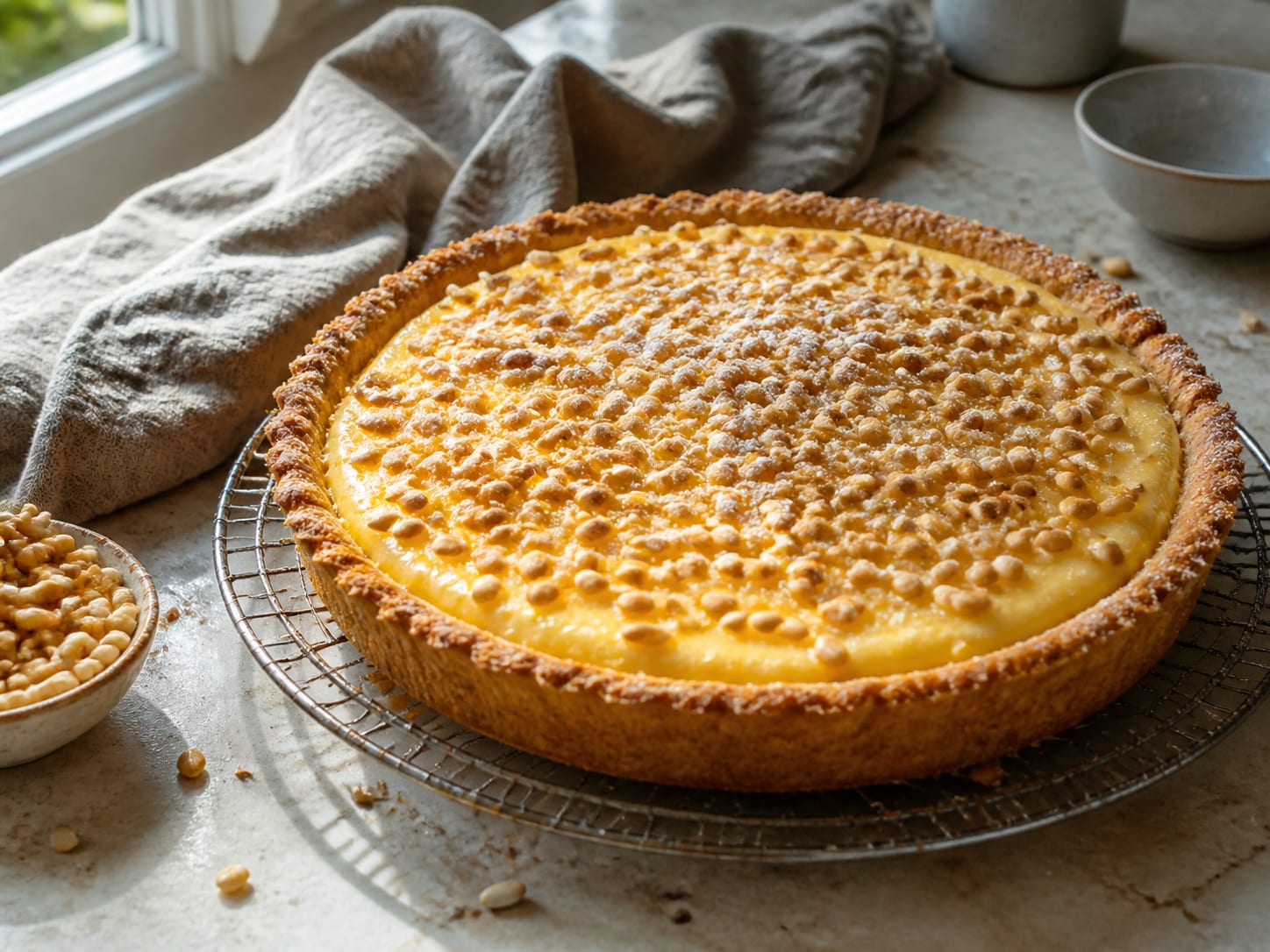
Torta della Nonna
A Tuscan custard tart, the pastry chilled thoroughly before rolling since a warm, soft dough tears and shrinks unpredictably in the oven, and the custard cooked on the stove until properly thick before it ever goes into the shell, since a runny custard baked directly in raw pastry never sets right and soaks the base soggy. Toasting the pine nuts before scattering them on top is what keeps their flavour from tasting flat against the rich custard.
Prep45 min
Cook45 min
Rest60 min
Servings4
Christoph's Torta della Nonna, the custard cooked properly thick on the stove before going into the raw pastry shell.
Ingredients
Written for a 26 cm round tin
Units
Temperature
Servings
Pastry
- 350 g flour rounded
- 150 g cold butter, cubed rounded
- 120 g sugar rounded
- 2 egg yolks rounded
- 1 g fine salt rounded
Custard
- 600 ml milk rounded
- 1 vanilla pod, split and scraped rounded
- 5 egg yolks rounded
- 120 g sugar rounded
- 50 g cornstarch rounded
- 60 g pine nuts rounded
- 30 g powdered sugar, for dusting rounded
Dietary labels are a guide, not a guarantee. If you have an allergy, read the ingredients yourself.
Method
- Combine the flour, cold butter, sugar and salt, rubbing together with your fingertips until it resembles coarse crumbs. Add the egg yolks and bring together into a dough. Divide in two, flatten into discs, and chill for 45 minutes.
- Heat the milk with the split vanilla pod and scraped seeds until just below a simmer.
- Whisk the egg yolks, sugar and cornstarch together. Slowly pour in a third of the hot milk while whisking constantly, then whisk this back into the remaining milk.
- Return to low heat and cook, whisking constantly, for 3 to 4 minutes, until thick enough to hold a ribbon trail. Transfer to a bowl, press plastic wrap directly onto the surface, and let cool completely.
- Preheat the oven to 180°C (fan). Roll out one disc of pastry and line a 26 cm tart tin. Pour in the cooled custard and smooth the top.
- Roll out the second disc and lay it over the custard, sealing the edges. Prick the top with a fork.
- Bake for 30 to 35 minutes, until deeply golden brown. Let cool completely.
- Toast the pine nuts in a dry pan for 2 to 3 minutes until fragrant. Scatter over the cooled tart and dust with powdered sugar.
Notes
- Cook the custard fully thick on the stove before it goes into the shell. A runny custard baked directly in raw pastry never sets right in the time the pastry needs to bake, and soaks the base soggy in the process.
- Chill the pastry thoroughly before rolling. Warm, soft dough tears easily and shrinks unpredictably as it bakes; cold dough holds its shape.
- Toast the pine nuts before scattering them on top. Raw pine nuts taste comparatively flat against the rich, vanilla custard; toasting brings out a depth that makes the topping worth including.
- It’s best the day after baking, once fully cooled and set, though it keeps for 3 days in the fridge.
Ingredient substitutions
- Pine nuts are traditional; sliced almonds are a reasonable substitute if pine nuts aren’t available.
- A little grated lemon zest in the custard is a traditional addition.
- Serve at room temperature, not chilled straight from the fridge, for the best texture.
From Christoph Mayer