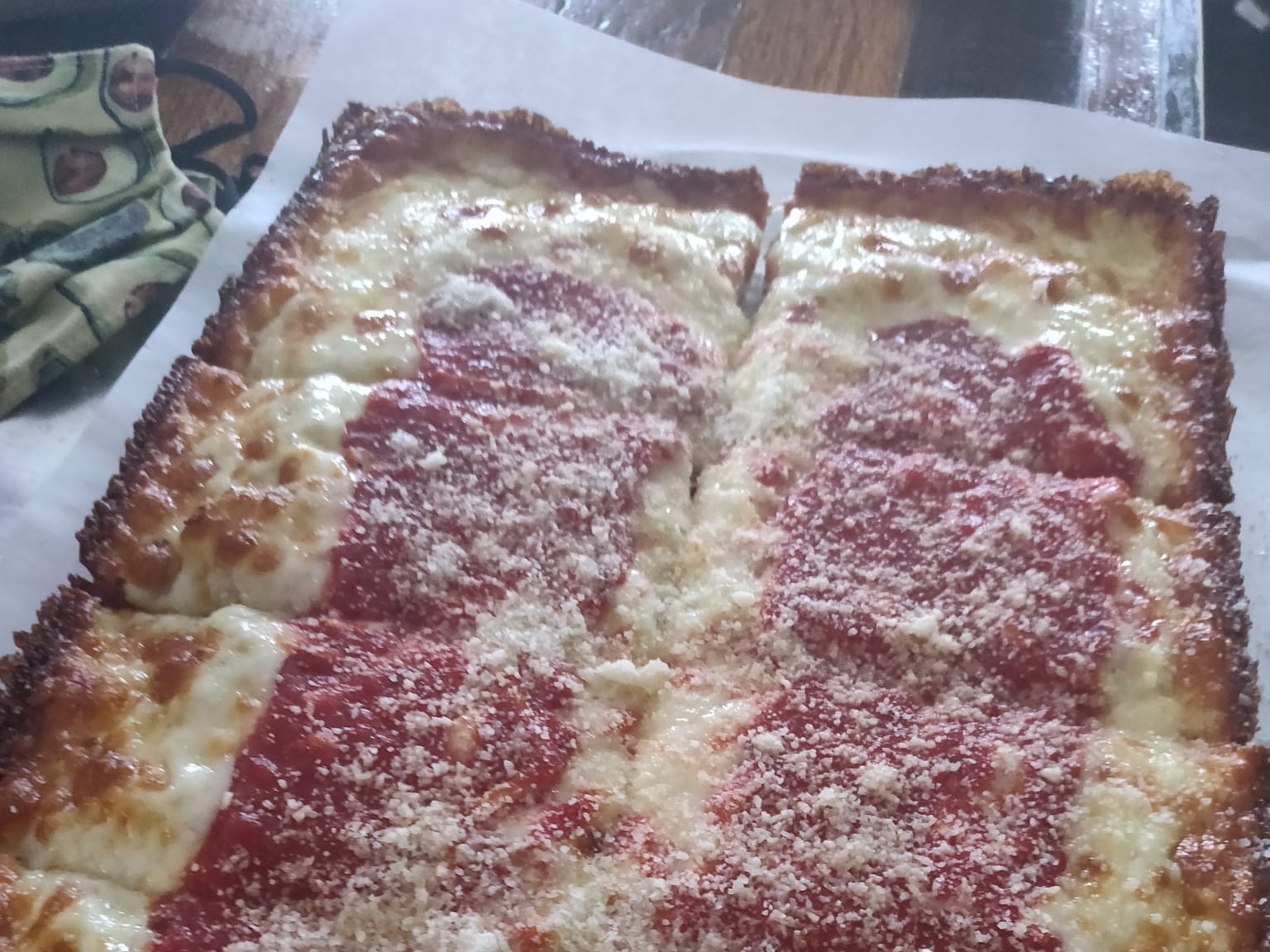

Two-pan thick-crust pizza
A no-mixer dough built by four bowl folds, held 12 to 72 hours in the fridge, then proofed in two oiled metal pans for a deep airy crumb and shallow-fried base.
Adapted from King Arthur Baking's Crispy Cheesy Pan Pizza, their 2020 Recipe of the Year, scaled by pan area to two 24 x 34 cm metal pans
Ingredients
Written for a 24 × 34 cm dish
Units
Temperature
Servings
Dough
- 750 g plain flour rounded
- 530 ml lukewarm water rounded
- 14 g fine salt rounded
- 5 g instant yeast rounded
- 41 g olive oil, for the dough rounded
For the pans
- 56 g olive oil, for the pans, 28 g in each rounded
Dietary labels are a guide, not a guarantee. If you have an allergy, read the ingredients yourself.
Method
- Day one. Mix. Put the 750 g flour, 531 ml lukewarm water, 14 g salt, 5 g yeast, and 41 g olive oil in a large bowl and stir for about a minute, until no dry flour is left. It will look sticky and rough. That is correct.
- Fold, four rounds, five minutes apart. Cover the bowl for 5 minutes. Wet one hand, lift one side of the dough, and fold it over the centre. Turn the bowl and repeat from all four sides. Do three more rounds at 5 minute intervals. Those four rounds are the kneading; there is no mixer in this recipe. By the last round the dough feels smoother and stronger and stretches instead of tearing. Do not add flour because it sticks.
- Rest, then chill. Cover and leave 40 minutes at room temperature, then refrigerate 12 to 72 hours. It should expand slowly and fill with bubbles. The fridge is where the flavour comes from, so 12 hours is the minimum rather than the target.
- Bake day, about 3 hours before you want to eat. Oil the pans and divide. Put 28 g of olive oil into each 24 x 34 cm pan. Divide the cold dough into two portions of about 670 g and turn each one over in the oil so it is coated on both sides.
- Press it out. Press the dough towards the corners of the pan. If it springs back, cover it, wait 15 minutes, and press again. It will get there. Forcing it tears the structure you spent a day building.
- Proof in the pan, about 2 hours at room temperature. It is ready when it looks puffy and soft and wobbles slightly as you move the pan.
- Heat the oven to 230°C conventional, or 215 to 220°C fan. For the crispest base, bake one pan at a time on a low rack.
- Use the topping selector. The topping selector below supplies exact quantities for one 30 cm reference pizza plus before-bake and after-bake steps. For these two pans together, prepare about 1.8 times a thick-crust-compatible preset. That is deliberately less than the full 2.31 surface-area ratio so the thick crumb bakes through. Divide it evenly and apply it gently so the proofed dough keeps its gas.
- Bake 18 to 24 minutes. If both pans go in at once, swap their rack positions and turn each pan after about 12 minutes.
- Out of the pan within a few minutes, onto a cooling rack. Left sitting in the pan it steams itself and the base you just built goes soft.
Notes
- Weigh the flour and the water. This is a wet, slack dough at about 71 percent hydration, and a cup measure is out by enough to change both pans. Weighing is also what keeps the two trays equal, which matters because they share an oven and a timer.
- Where the odd numbers come from. The quantities are the King Arthur recipe scaled by pan area, 3.123 times the original, from a 22.86 cm square pan to two of 24 x 34 cm. That is why the water is 531 g and the oil 41 g rather than round numbers. Round them if you like, but scale them together.
- The oil in the pan is not greasing, it is the cooking method. 28 g per pan is enough for the base to shallow-fry rather than bake, which is where the crisp underside comes from. It is not a quantity to trim, and it does not scale with the dough.
- Topping capacity. The two pans total 1632 cm² versus about 707 cm² for the selector’s 30 cm reference circle. Use about 1.8 times a selected preset, not one preset and not the full 2.31 area ratio, because the deeper bread-like base needs a restrained load. The selector owns moisture controls, assembly order, and finishing. This page owns the two-pan dough, its long cold ferment, the measured pan oil, and the crisping bake.
- What the dough should feel like. Sticky and rough after mixing, smooth and strong after the fourth fold, puffy and slightly jiggly after the pan proof. A dough that is still dense and tight when it goes into the oven bakes dense, and no extra oven time fixes that.
- Troubleshooting. Pale bottom: keep it on the lowest rack another 2 to 4 minutes. Top browning too fast: move the pan lower and let the crust finish. Soggy centre: less sauce, drier cheese, and out of the pan promptly. Dense crumb: the pan proof was short. Reheating: 200°C on a rack, or a dry skillet on the hob, until the base is crisp again.
- Equipment. One large bowl, a sturdy spoon or spatula, a scale, two 24 x 34 cm metal pans, and a cooling rack. Metal, not glass or ceramic; the base needs conducted heat from below.
Sources consulted
- King Arthur Baking: Crispy Cheesy Pan Pizza
- King Arthur Baking: Introducing our 2020 Recipe of the Year
Good with
- Baked zucchini-feta fritters with herbed yogurt
- Greek salad with sardines
- Grilled veg and chickpea pasta salad
- House tomato pizza sauce
Sources consulted
From Christoph Mayer