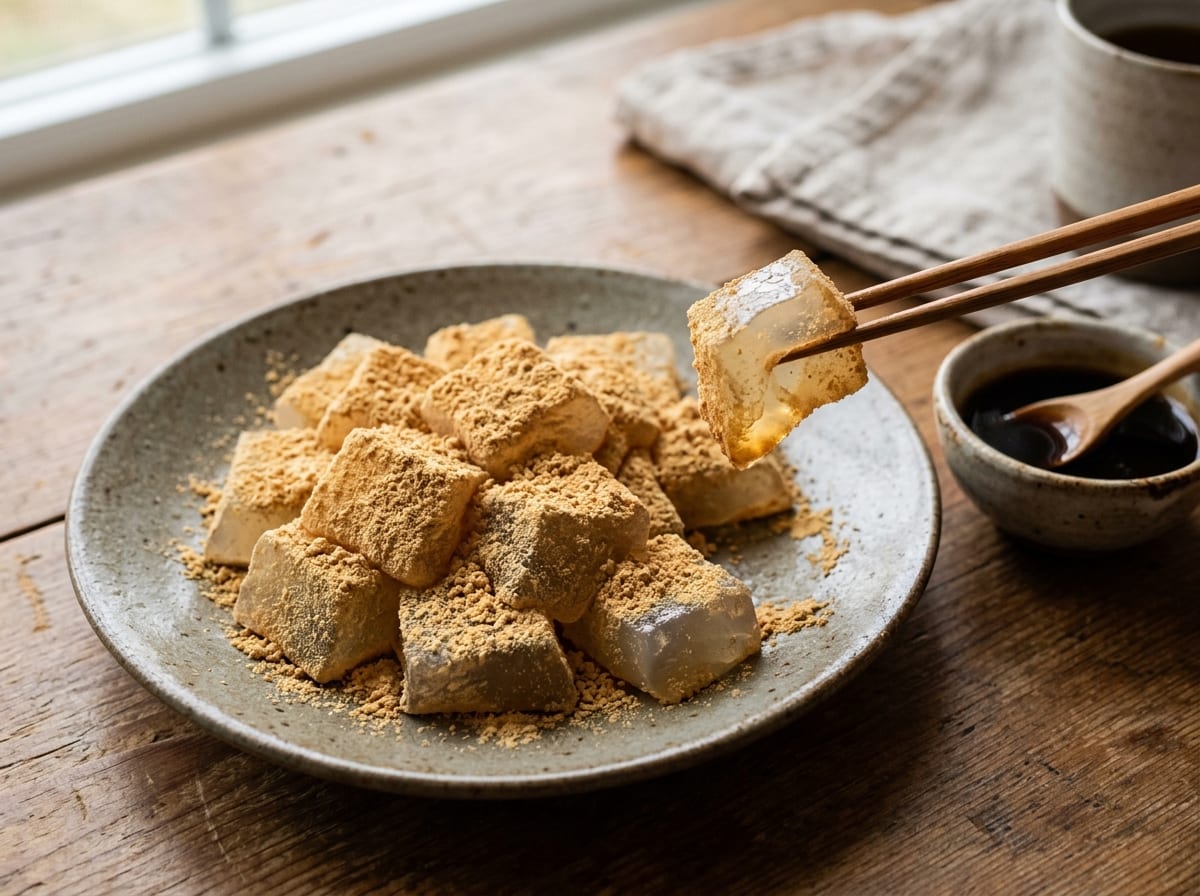
Warabi mochi
A jiggly, translucent Japanese starch jelly: briefly cooked on the stovetop, chilled until set, cut into cubes, and dusted heavily in roasted soybean flour with a dark brown sugar syrup drizzled over. A cold, no-fuss wagashi for summer, made here with tapioca or sweet potato starch since true bracken starch isn't sold outside Japan.
Technique and ratios adapted from Just One Cookbook's warabi mochi recipe, with substitution guidance from Honest Food Talks
Ingredients
Written for a 1.5 L pot
Warabi mochi
- 130 g tapioca starch, or sweet potato starch, see Notes on substituting for true bracken starch rounded
- 110 g granulated sugar rounded
- 550 ml cold water rounded
Kinako coating
- 45 g kinako (roasted soybean flour), for dusting the tray and coating the cubes rounded
Kuromitsu (brown sugar syrup)
- 100 g dark brown sugar rounded
- 100 ml water rounded
Dietary labels are a guide, not a guarantee. If you have an allergy, read the ingredients yourself.
Method
- Dust a small baking sheet or shallow tray with about a third of the kinako, so the hot mochi mixture has somewhere dry to land and won’t stick.
- In a medium saucepan, off the heat, whisk the tapioca starch, sugar, and cold water together until completely smooth with no lumps. Do this cold, before the pan ever touches heat: starch clumps the instant it hits a hot surface.
- Set the pan over medium heat and cook, stirring constantly with a silicone spatula or wooden spoon. The mixture will turn cloudy and lumpy before it turns smooth again, keep stirring through that stage rather than second-guessing it.
- After 8 to 10 minutes it thickens sharply: thick, glossy, and fully translucent, pulling together into a mass that clears the sides of the pan as you stir. That is the doneness cue. Pull it off the heat as soon as you see it; extra time past this point toughens it.
- Working quickly while it is still hot and pliable, scrape the mixture onto the prepared kinako-dusted tray in a rough, even layer about 2 cm thick. Dust the top with more kinako so it doesn’t skin over as it cools.
- Let it cool at room temperature for about 10 minutes, then transfer to the fridge, uncovered, until fully set and cold, about 1 hour.
- Meanwhile, make the kuromitsu: combine the dark brown sugar and water in a small saucepan, bring to a boil, then reduce to a bare simmer and cook for 15 to 20 minutes, stirring occasionally, until syrupy. Cool before serving.
- Turn the set block out onto a cutting board dusted with the remaining kinako. Cut into roughly 2 to 3 cm cubes with a knife wiped wet, which keeps the blade from dragging and sticking.
- Toss the cubes gently in the last of the kinako to coat every side. Serve chilled or at cool room temperature, in small bowls, with kuromitsu drizzled over just before eating.
Notes
- True warabiko, bracken starch made from the pounded rhizome of the bracken fern, is essentially unobtainable outside Japan, and even inside Japan the hand-made version is scarce and expensive. Tapioca starch and sweet potato starch are the accepted substitutes, both in Japan and abroad, and either works here in the same weight as the starch called for. The texture differs a little from true warabiko: less of that soft, faintly grainy pull, more uniformly bouncy and glassy. Neither is wrong, just different.
- The water-to-starch ratio here (about 4 to 1 by weight) gives cubes firm enough to cut cleanly and hold their shape. Adding more water makes a softer, more delicate result that won’t hold a cube shape as well.
- Warabi mochi is best the day it’s made and within a few hours of cutting. Once fully chilled, keep it at cool room temperature rather than in the fridge: prolonged refrigeration seizes the starch, turning the mochi opaque, dry, and tough instead of jiggly.
- Kuromitsu keeps well refrigerated for a couple of weeks; make extra, it’s good over ice cream and shaved ice too.
- Dust generously, not delicately. A heavy kinako coating is both traditional and functional: it keeps the pieces from welding back together in the bowl.
Sources Consulted
- Just One Cookbook, “Warabi Mochi わらび餅”
- Honest Food Talks, “Warabi Mochi Recipe With Bracken Starch Or Tapioca Starch”
The starch-sugar-water ratio, the stovetop thickening technique, and the kinako-dusted tray come from Just One Cookbook. The starch substitution discussion draws on Honest Food Talks. Quantities scaled for a batch of six, and all wording, is original.
From Christoph Mayer