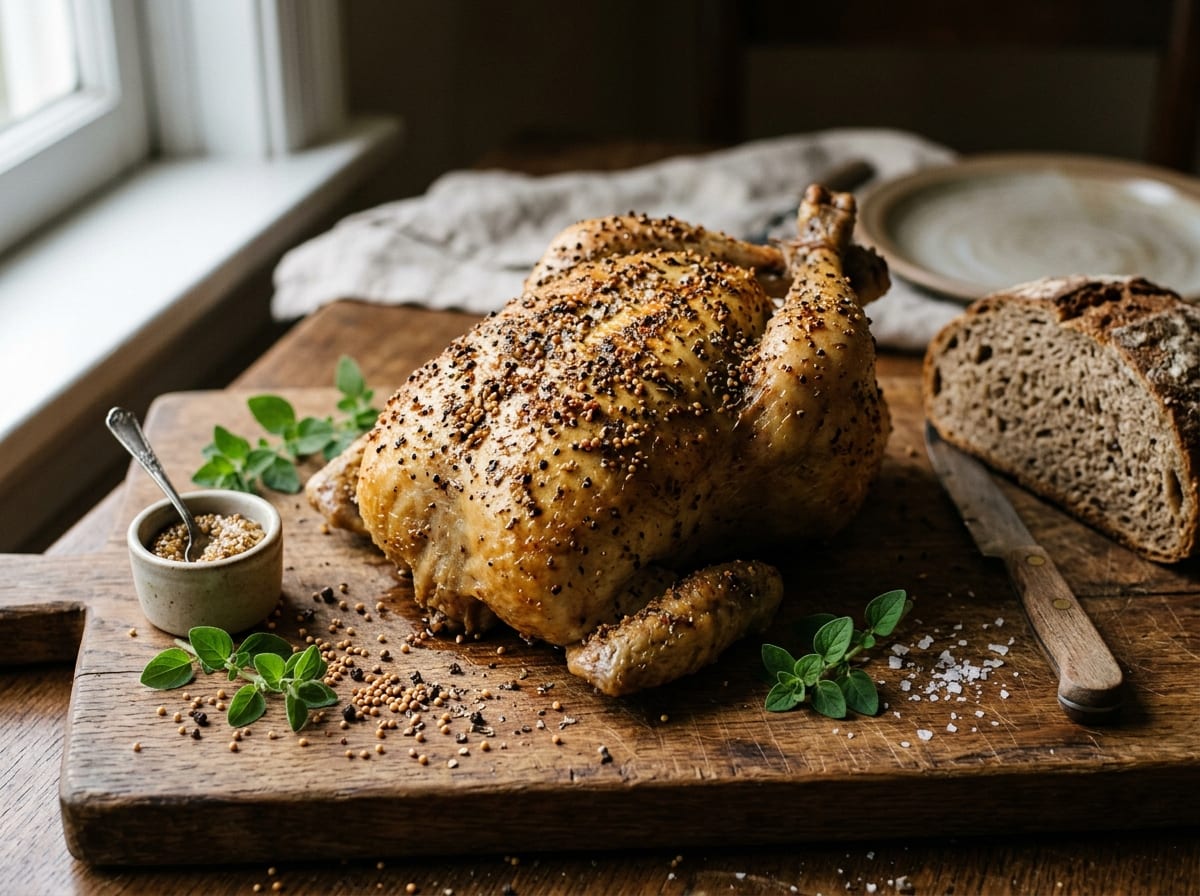
Weissbier and mustard beer can chicken
A Hefeweizen's clove-and-banana yeast character and low carbonation suit a mustard-forward rub better than a hoppy beer would, so it goes in the can instead of a lager. The rub itself pulls from German charcuterie, coarse mustard, caraway, marjoram, and a mustard butter goes on only in the last fifteen minutes, brushed on thin rather than poured.
The vertical beer-can method turned German, a wet, mustard-forward rub in place of an American barbecue spice mix, and a Hefeweizen in the can for its yeast character rather than a hoppy lager.
Ingredients
Units
Temperature
Servings
Chicken
- 1 whole chicken, about 1.6 to 1.8 kg rounded
- 1 Hefeweizen (German wheat beer), 500 ml can or bottle, opened, with about a third poured off before use rounded
Mustard rub
- 50 g coarse whole-grain mustard, German-style and mittelscharf, not sweet American ballpark mustard rounded
- 15 g caraway seed, lightly crushed rounded
- 6 g dried marjoram rounded
- 8 g coarse black pepper rounded
- 20 g coarse salt rounded
- 2 garlic, finely grated rounded
- 15 ml neutral oil, to loosen the paste so it spreads rounded
Mustard butter baste
- 50 g butter, melted rounded
- 20 g coarse whole-grain mustard rounded
- 30 ml Weissbier, the beer reserved from the can rounded
Method
- Take the chicken out of the fridge 30 minutes ahead and pat it thoroughly dry, inside and out. Wet skin steams instead of crisping, mustard rub or not.
- Build the rub. Stir the mustard, crushed caraway, marjoram, pepper, salt, garlic and oil into a coarse, spreadable paste. This is closer to the wet crusts used on German roasts and hams than to an American dry rub: the mustard is the binder, not an afterthought brushed on later.
- Work it under the breast skin with your fingers first, then over the whole bird, into the thigh creases, the underside, the wings. Let it sit at room temperature while you set up the grill, or uncovered in the fridge overnight if you have the time and want firmer skin the next day.
- Open the beer and pour off about a third into a small cup or jar; you’ll want it for the baste later. Leave the rest in the can, or pour it into a vertical roaster’s reservoir if you’re using a stand instead of a can.
- Set up for indirect heat, 180 to 200°C, coals or burners banked to one side of the grill, a drip tray under where the bird will sit. In the oven, 200°C on a roasting rack does the same job with less fuss and no smoke.
- Lower the chicken onto the can or stand, legs down, so it’s fully upright and stable on its own three points of contact (the can and the two legs). Check it doesn’t lean before you commit it to the grate or the rack.
- Cook over indirect heat, lid down, 65 to 80 minutes. If your heat source sits to one side rather than surrounding the bird, give the stand a quarter turn every 20 minutes or so for even browning.
- In the last 15 minutes, brush with the mustard butter, the melted butter, reserved beer and extra mustard whisked together, every five minutes or so, in thin coats rather than one heavy pour. A thin coat sets; a thick one slides off into the drip tray.
- Pull the breast at 74°C, and let the thighs continue to 80°C if they’re lagging behind, on the vertical stand they’re usually there first, not last. Rest 15 minutes standing up, then lift the bird off the can carefully (tongs in the cavity, an oven mitt on the can itself, which will be hot) before carving.
Notes
- The beer’s real contribution is modest, and it’s honest to say so. The can stays too cool to produce meaningful steam: fat renders down and seals the opening early in the cook, and taste tests comparing a beer can against a can of water or dried beans of the same weight come back the same. What the beer actually does here is aromatic: a little of it goes into the baste, where its clove-and-banana Hefeweizen character carries into the crust, and whatever escapes as vapour perfumes the air right around the cavity while it cooks. That’s a smaller effect than the rub, but a real one, and different from the folk idea that the beer bastes the meat from the inside.
- Why a Hefeweizen and not a lager. A hoppy pilsner or lager fights a mustard-forward rub: the bitterness and the mustard’s sharpness compete rather than layer. A wheat beer’s yeast character (clove, banana ester, a little bread) sits alongside caraway and marjoram the way it would in a German kitchen already, and its lower carbonation means less fizzing and spitting as the can heats.
- The vertical setup’s real job is airflow, not basting. Standing the bird up exposes skin on every side to the same convective heat at once, rather than leaving one side pressed against a roasting pan. That’s what gives even, all-over browning on a grill: the mechanism is about hot air reaching all the skin, not liquid moving upward from the can.
- Mustard paste over dry rub because mustard’s acidity and moisture do real work on the surface protein during that fridge rest, the way a wet cure would, and it holds the caraway and marjoram against the skin through the whole cook instead of shedding into the coals.
- Ahead. The rub can go on up to 24 hours ahead, uncovered in the fridge, it only improves. The mustard butter can be mixed a day ahead and rewarmed gently before brushing.
Ingredient substitutions
- No Hefeweizen. An alcohol-free Weißbier keeps the same yeast character with none of the concern about the can heating alcohol. A Kölsch or pilsner works in a pinch but loses the clove-banana note the rub is built around. For a non-alcoholic can with no beer at all, apple juice with a splash of cider vinegar gets closer than water does.
- No coarse mustard. Dijon is smoother but otherwise close; stir in a teaspoon of whole yellow mustard seed to get some of the texture back.
- No marjoram. Oregano is the closest relative in the kitchen, but it’s more assertive, use about two-thirds the amount.
- No can or vertical stand. Spatchcock the bird and roast it flat at the same 180 to 200°C, skin side up, checking at the same internal temperatures. Given how little the can itself does for the meat, this loses very little beyond the shape on the plate.
Sources consulted
- USDA: safe minimum internal temperature chart
- AmazingRibs: beer can chicken, and why it isn’t doing what people think
Good with
Sources consulted
From Christoph Mayer