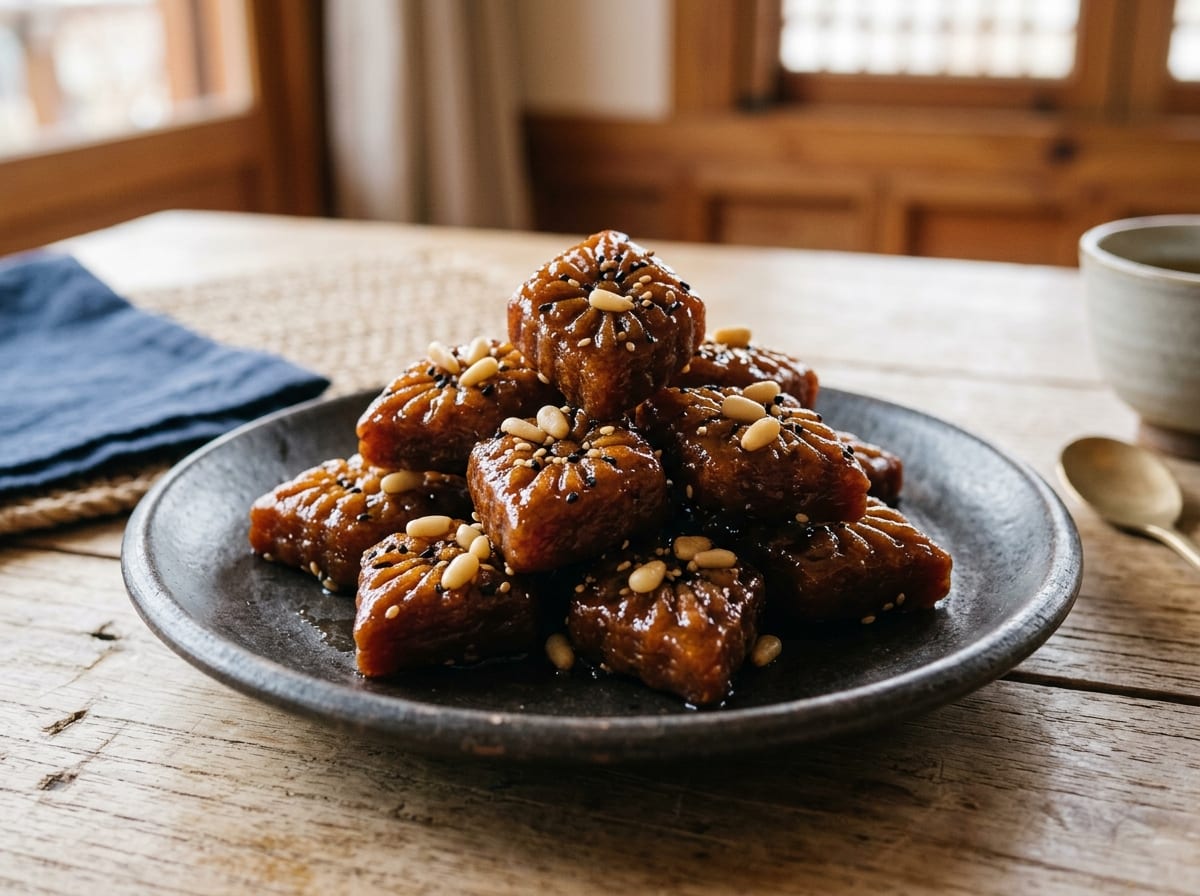
Yakgwa
Korea's ceremonial honey cookie, a sesame-oil-rubbed dough of flour, sweet rice flour, and cinnamon cut into diamonds, fried twice for a flaky, layered crumb, then soaked for hours in a ginger-honey syrup until dense, dark, and glazed.
Dough ratio and metric quantities from Beyond Kimchee's yakgwa, double-fry temperatures and syrup-soak timing cross-checked against Cooking with Casey and Kimchimari.
Ingredients
Written for a 3 L pot
Dough
- 210 g all-purpose flour rounded
- 80 g sweet rice flour, glutinous rice flour, sold as chapssalgaru or mochiko rounded
- 2 g ground cinnamon rounded
- 60 ml toasted sesame oil rounded
- 120 ml hot water rounded
- 60 ml honey rounded
- 50 g sugar rounded
- 2 g fine salt rounded
- 1 3/4 L neutral frying oil, enough for about 6 cm depth in a 20 cm pot, a high-smoke-point oil such as peanut or canola rounded
Honey-ginger syrup
- 375 ml rice syrup, jocheong, or a mild corn syrup or golden syrup if unavailable rounded
- 160 ml honey rounded
- 30 g fresh ginger, thinly sliced rounded
- 3 g ground cinnamon rounded
- 150 ml water rounded
Dietary labels are a guide, not a guarantee. If you have an allergy, read the ingredients yourself.
Method
- Whisk the flour, sweet rice flour, and cinnamon together in a wide bowl. Add the sesame oil and rub it into the flour with your fingertips, the way you would rub butter into a pie dough, until the mixture looks like damp sand and holds together briefly when pressed. This step is what gives yakgwa its flaky, layered crumb; do not skip it or shortcut it by stirring the oil in instead.
- Stir the honey and sugar into the hot water until dissolved, then stir in the salt. Let it cool until only warm, then pour it into the flour mixture. Fold everything into a shaggy dough with a spatula or your hand, just until it comes together. Do not knead it. Working the dough develops gluten, which turns a flaky yakgwa into a tough one.
- Press the dough into a rough block, wrap it, and rest it in the refrigerator for 1 hour. This relaxes the dough and lets the oil settle evenly through the layers, so it fries without cracking.
- While the dough rests, make the syrup. Combine the rice syrup, honey, ginger, cinnamon, and water in a small saucepan and bring to a simmer. Cook, stirring occasionally, for 8 to 10 minutes, until it coats the back of a spoon and drips slowly rather than running. Take it off the heat and let it cool completely; it needs to be at room temperature before the hot cookies go in, or it thins out and never sets back up.
- Roll the rested dough out on a lightly floured surface to about 1 cm thick. Cut it into a grid of diamonds roughly 4 cm across, a knife or pizza cutter works well. Pierce the centre of each diamond through with a skewer or chopstick; this lets steam escape evenly so the pieces puff instead of splitting.
- Pour the frying oil into a heavy pot to a depth of about 6 cm and heat it to 130°C. Fry the diamonds in batches of 6 to 8, without crowding the pot, until they rise to the surface and are barely coloured, about 7 to 9 minutes. This first, slow fry cooks the dough through and opens the layers; rushing it with hotter oil seals the crust before the inside is done.
- Once a batch has fully risen and puffed, lift it out and raise the oil to 170°C. Return the batch and fry a further 2 to 4 minutes, until deep amber-brown on every side. Lift onto a rack to drain briefly, then repeat the two-stage fry with the remaining batches, letting the oil come back down to 130°C between batches.
- While still warm, drop the fried cookies straight into the cooled syrup, pushing them under so they are fully submerged. Let them soak at room temperature for at least 4 hours, turning them once or twice so both sides take up the syrup evenly. Overnight, or up to 24 hours, is better still, and is closer to how they are traditionally made for a holiday table.
- Lift the cookies out of the syrup, letting the excess drip back into the pot, and arrange them on a plate. They should feel dense and slightly tacky on the surface, not dry.
Notes
- The oil-rubbing step is not optional. Yakgwa’s texture, dozens of thin, flaky layers rather than a single dense crumb, comes entirely from rubbing sesame oil into the dry flour before any liquid goes in, the same principle as a laminated pastry or a good pie crust. Stir the oil in instead and the cookies fry up dense and bread-like.
- Two fry temperatures, not one. A single hot fry browns the outside before the inside is cooked, which is exactly backwards for a dough this thick. The first, cooler fry gives the dough time to cook through and the layers time to lift apart; the second, hotter fry is only there to colour and crisp what is already cooked. A scrap of dough dropped in the oil should sink and rise slowly at 130°C, and sizzle hard immediately at 170°C.
- The syrup soak is the actual point. A yakgwa that has only sat in syrup for twenty minutes is still a fried cookie with a wet outside. Four hours is the minimum for the syrup to work its way in and the texture to turn dense and slightly chewy; a full day gets you the deeply soaked, almost fudgy cookie that shows up at Korean holidays and ancestral rites. Plan for this, it is the longest single step in the recipe by far.
- Storage. Yakgwa is a make-ahead sweet by design. Kept in an airtight container at cool room temperature, it holds for 5 to 7 days, and the flavour, if anything, improves after the first day. Refrigerated, it keeps for up to 2 weeks; let it come back to room temperature before serving, it is unpleasantly firm straight from the fridge.
- If jocheong is hard to find, a mild light corn syrup or a golden syrup thinned with a spoon of water is a reasonable stand-in, though the flavour will be plainer.
Sources Consulted
- Beyond Kimchee, “Yakgwa (Korean Honey Cookies)”
- Cooking with Casey, “Authentic Yakgwa Recipe”
- Kimchimari, “Korean Honey Pastry (약과 Yakgwa or Yakwa)”
Beyond Kimchee gives the clearest metric dough and syrup quantities and is the base of this recipe, landing close to the requested 18-cookie yield without rescaling. Cooking with Casey and several other Korean home cooks agree on the two-stage fry, oil starting around 130°C until the diamonds rise and puff, then raised toward 160 to 170°C to brown, and those numbers are used here in place of Beyond Kimchee's single-stage version, since the double fry is what gives yakgwa its layered, flaky crumb rather than a dense fritter. Sources disagree sharply on soak time, anywhere from 20 minutes to two full days, so this recipe asks for a minimum of 4 hours, enough to glaze and soften the crust, and notes that overnight to 24 hours, the more traditional holiday approach, gives a denser, more evenly soaked cookie. Wording and method phrasing are original.
From Christoph Mayer