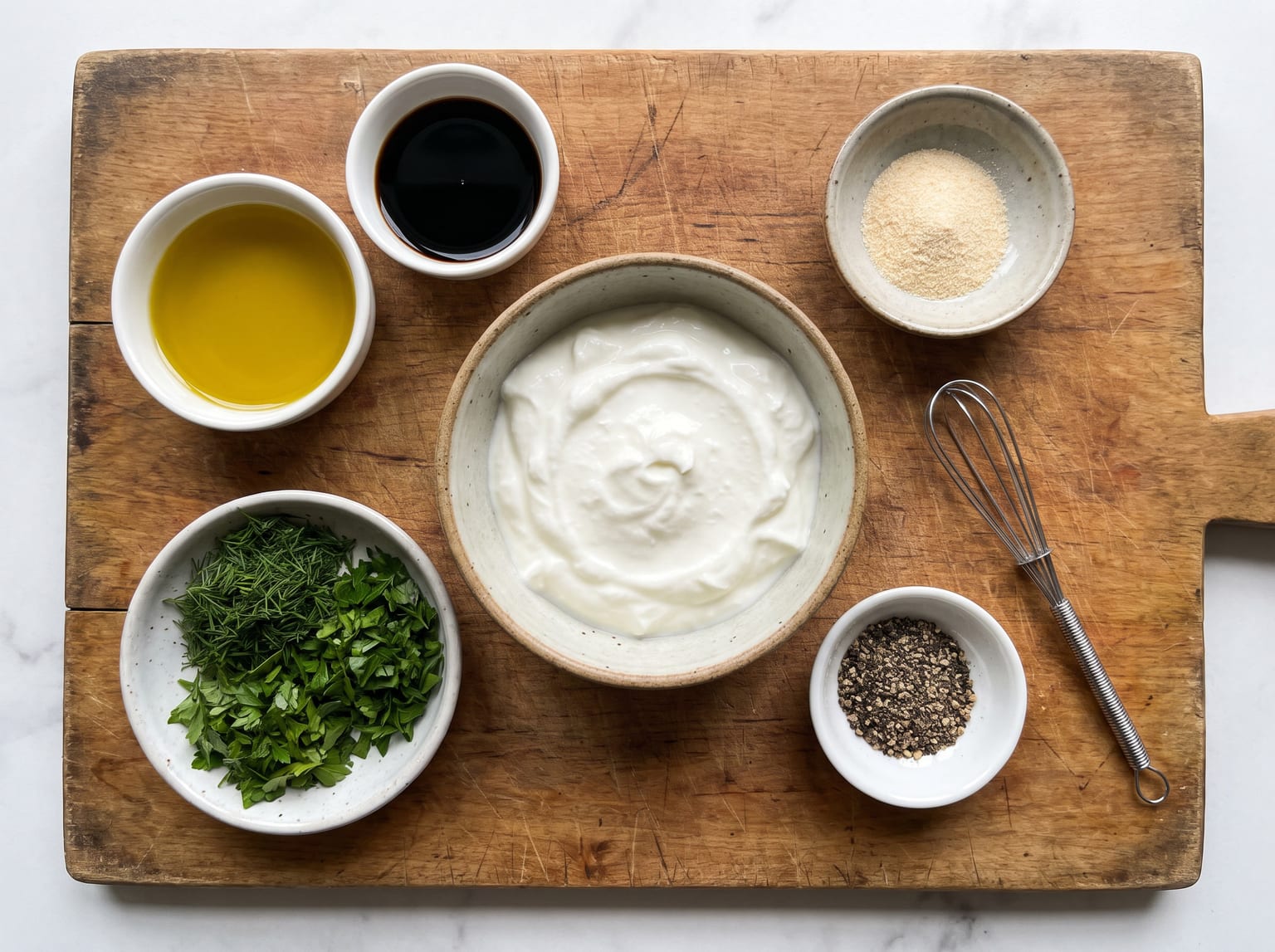
Yogurt dressings, by ratio
One base that becomes ranch, caesar, green goddess, honey mustard or tzatziki depending on four decisions. Greek yogurt for the body, an acid, a fat, and whatever you want it to taste of. Every one of them is high in protein because the base is.
The house method, written as a ratio because every version is the same base
Ingredients
The base
- 250 g Greek yogurt, full fat, 10 percent; this is the body and most of the protein rounded
- 40 ml acid, lemon juice, vinegar, pickle brine, or buttermilk; see the table rounded
- 30 ml olive oil, for mouthfeel; leave it out and it tastes thin however thick it looks rounded
- 5 g fine salt, always last, because half the flavourings are salty rounded
- 3 g coarse black pepper rounded
Flavouring, pick one column from the table
- 20 g fresh herbs or aromatics, the character; see the table below rounded
- 10 g a savoury note, mustard, anchovy, miso, parmesan or garlic powder rounded
Dietary labels are a guide, not a guarantee. If you have an allergy, read the ingredients yourself.
Method
- Yogurt and acid first, whisked smooth. Always start with the thinnest thing.
- Oil in a thin stream, whisking.
- Flavourings, then taste, then salt.
- Rest 30 minutes. Dried herbs need to rehydrate and raw garlic needs to settle. Every version of this is better after an hour.
The table
Same base, four decisions. Quantities are per 250 g of yogurt.
| Version | Acid (40 ml) | Herb or aromatic (20 g) | Savoury note (10 g) | Also add |
|---|---|---|---|---|
| Ranch | buttermilk | chives, parsley, dill | onion and garlic powder | 1 tbsp mayonnaise |
| Caesar | lemon | parsley | 2 anchovies, 1 tsp Dijon | 30 g parmesan |
| Green goddess | lemon and vinegar | basil, parsley, tarragon, chives | 1 anchovy | blend it smooth |
| Tzatziki | lemon | dill and mint | 1 grated garlic clove | 150 g drained grated cucumber |
| Honey mustard | cider vinegar | none | 20 g Dijon | 20 g honey |
| Dill pickle | pickle brine | dill | garlic powder | more pepper than feels right |
| Harissa | lemon | coriander | 20 g harissa | pinch of cumin |
| Blue cheese | white wine vinegar | chives | none | 80 g crumbled blue cheese |
| Peanut lime | lime juice and rice vinegar | coriander | 40 g peanut butter, 1 tbsp soy | grated ginger |
| Tahini lemon | lemon | parsley | 50 g tahini | thin with water, not oil |
The same bowl, in other countries
Half the world has a yogurt and cucumber dish, and they are not variations on tzatziki so much as siblings. Once you see that they differ by only three decisions, the whole family opens up.
| Dish | From | Water | Herb | What makes it itself |
|---|---|---|---|---|
| Tzatziki | Greece | none, cucumber wrung dry | dill | vinegar rather than lemon, and thick enough to scoop |
| Cacık | Turkey | thinned until pourable | dried mint | eaten with a spoon, not a dip |
| Haydari | Turkey | none, often strained further | dill and mint | feta or drained yogurt beaten in, thick as a spread |
| Talattouri | Cyprus | none | mint rather than dill | much more garlic than the Greek version |
| Mast-o-khiar | Iran | a little | dried mint | walnuts, raisins and dried rose petals, and no garlic at all |
| Raita | India | a little | coriander | toasted cumin seed, sometimes mustard seed and green chilli |
| Khyar bi laban | Levant | a little | mint | garlic crushed with salt, and often no oil |
| Snezhanka | Bulgaria | none, strained hard | dill | walnuts, and served as a starter rather than a sauce |
| Doogh and ayran | Iran and Turkey | thinned to a drink | dried mint | salted, sometimes sparkling, and drunk cold |
The three decisions are how much water, which herb, and what goes in for texture. Dill points to Greece and the Balkans, mint to Turkey and Persia, coriander to South Asia. Walnuts appear from Bulgaria to Iran and almost nowhere west of that.
The one worth making next is mast-o-khiar. Walnuts, raisins and rose petals sound like a dessert written into a savoury dish, and it is the most interesting bowl on the list. It is also the only one here with no garlic, which is what lets the fruit and the rose read at all.
Dressing or dip
The same bowl does both. As written it is a thick dressing. For a dip, halve the acid and leave the oil out. For something thin enough to pour over a grain bowl, add another 40 ml of acid or a splash of water.
Notes
- Why yogurt rather than a vinaigrette. Three times the protein, a fraction of the fat, and it clings to leaves instead of sliding to the bottom of the bowl. A standard oil-and-vinegar dressing is about 90 percent fat by calories; this is about 40.
- Full fat, always. Zero percent yogurt splits when you whisk oil into it and tastes chalky. Ten percent Greek yogurt or skyr is the base worth using.
- Salt last, every time. Anchovy, parmesan, miso, pickle brine and blue cheese are all salty, and the versions above vary enormously in how much salt they need.
- To keep it vegetarian, leave the anchovies out. Only the caesar and the green goddess call for them. The nearest replacement is a teaspoon of white miso for each anchovy, which is already on the savoury list above, plus a few chopped capers and a splash of their brine for the sharp edge that miso does not have. A pinch of nori or dulse flakes adds the sea note if you want the full effect. Worcestershire sauce is not the way round it, because the standard bottle is made with anchovy as well.
- Garlic powder in anything that will sit. Fresh garlic gets sharp and slightly bitter in yogurt after a day. If it is being eaten within the hour, fresh is better.
- They keep 5 to 7 days, except the ones with fresh herbs blended in, which go dull and grey-green after about three.
- If it splits, it was too cold or the oil went in too fast. Whisk in a spoon of fresh yogurt and it comes back.
Ingredient substitutions
- Skyr has more protein and less fat and makes a sharper dressing. Labneh thinned with water is richer. Plain yogurt needs straining first or the result is too loose.
- Dairy-free. Thick coconut yogurt works for the peanut lime and harissa versions. It fights the caesar and the ranch.
Sources consulted
Good with
From Christoph Mayer