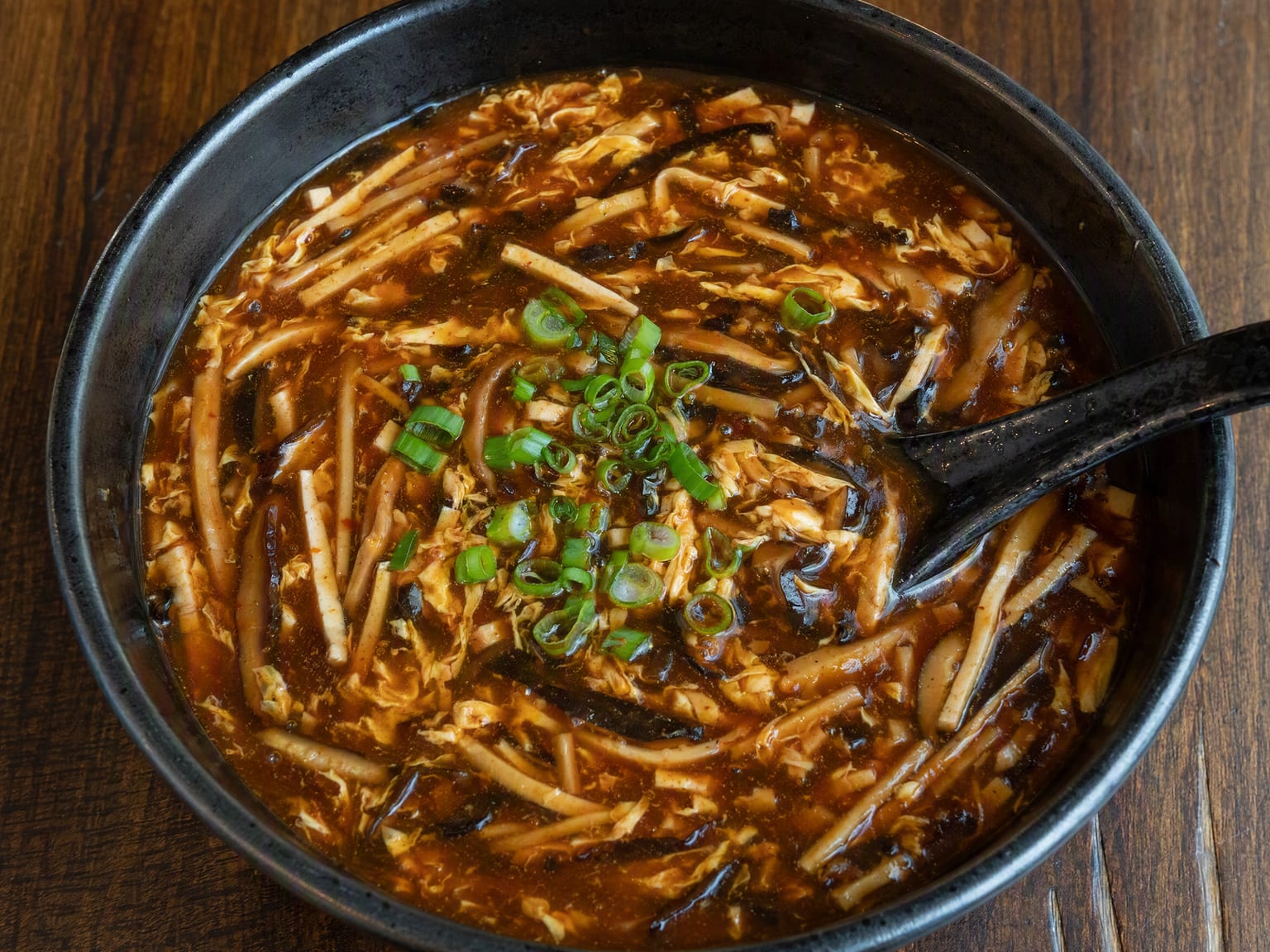
Soup Chinese restaurant-style Chinese Dairy-free Nut-free
Hot and Sour Soup
The takeout counter classic, where the heat comes from white pepper rather than chilli and the sourness from plain distilled vinegar, both stirred in at the very end because both cook off. Getting it right at home is mostly about restraint with the cornstarch slurry, since the soup should be thick enough to coat a spoon and still be soup, not the gluey version that sets solid as it cools.
Adapted from RecipeTin Eats and The Woks of Life, both of which insist on white pepper for the heat and plain distilled vinegar for the sourness.
Ingredients
Written for a 4 L pot
Pork or chicken and its marinade
- 200 g pork shoulder or chicken breast, cut into fine matchsticks rounded
- 15 ml water rounded
- 5 g cornflour rounded
- 10 ml neutral oil rounded
Soup
- 1 1/2 L chicken stock, low salt, since the soy sauces season it rounded
- 12 dried shiitake mushrooms, soaked in hot water until soft, then sliced; or 150 g fresh rounded
- 25 g dried wood ear mushrooms, soaked until soft, then chopped; see substitutions rounded
- 60 g bamboo shoots, from a tin, drained and thinly sliced rounded
- 200 g firm tofu, cut into matchsticks to match the pork rounded
- 5 g fresh ginger, finely grated rounded
- 15 ml light soy sauce rounded
- 10 ml dark soy sauce, for colour more than salt rounded
- 4 g sugar rounded
Thickening and finishing
- 40 g cornflour rounded
- 125 ml cold water rounded
- 2 eggs, beaten rounded
- 65 ml distilled white vinegar, added off the heat, adjust to taste rounded
- 3 g ground white pepper, this is the heat, not chilli rounded
- 5 ml toasted sesame oil rounded
- 2 scallions, finely sliced rounded
Dietary labels are a guide, not a guarantee. If you have an allergy, read the ingredients yourself.
Method
- Marinate the meat. Mix the pork or chicken matchsticks with the water until it is absorbed, then the cornflour and oil. This is velveting in miniature and it is why restaurant meat stays tender in a soup that simmers.
- Soak the dried mushrooms in hot water for at least 30 minutes, or 1 to 2 hours in cold. Squeeze them out, slice the shiitake, chop the wood ears, and keep the soaking liquid if you want extra depth, straining off the grit at the bottom.
- Bring the stock to a boil in a large pot. Add the meat, breaking up any clumps as it goes in, and skim off the foam that rises.
- Season the broth. Add both soy sauces, the sugar and the ginger, then the shiitake, wood ears and bamboo shoots. Bring back to a simmer and add the tofu. Simmer 3 to 4 minutes.
- Thicken carefully. Mix the cornflour and cold water into a smooth slurry. Stir the simmering soup in a slow circle and drizzle in about three quarters of the slurry, then stop and let it come back to a simmer before judging. It should coat a spoon. Add the rest only if you want it thicker; this is the step that separates soup from glue.
- Add the egg in ribbons. Keep the soup at a bare simmer and moving in a slow circle, then drizzle the beaten egg in a thin stream from a height. Do not stir hard afterwards. Moving soup and a thin stream give you ribbons; a still pot or a fast stir gives you cloud.
- Finish off the heat. Take the pot off the stove and only then stir in the vinegar, white pepper and sesame oil. Both the vinegar and the pepper lose their edge if they boil, which is the single most common reason a homemade version tastes flat. Taste and push the sourness or the heat further if you want. Scatter scallions over the bowls.
Notes
- White pepper is the heat and vinegar is the sour, and both go in last. If you find yourself adding chilli to make it hot, add more white pepper instead; that is what the takeout version is doing.
- Cut everything to matchsticks of roughly the same size, meat, tofu, mushrooms and bamboo alike. The texture of this soup is the point, and it only reads correctly when a spoonful carries a bit of everything.
- It thickens further as it cools, so err on the loose side. Reheated leftovers usually need a splash of stock to come back.
- A vegetarian version is straightforward. Use vegetable or mushroom stock, drop the meat and double the tofu, and check the dark soy for anchovy, which some brands contain.
Ingredient substitutions
- Wood ear mushrooms give the soup its distinctive slippery crunch and have no real equivalent. Dried is the normal form and Asian grocers in Germany (Mu-Err-Pilze, often sold for Asian cooking) and Canada stock them cheaply. Without them the soup still works, but add extra shiitake and accept it is a softer bowl.
- Distilled white vinegar is the correct one here, not Chinese black vinegar and not rice vinegar. Black vinegar is malty and takes the soup somewhere else, which is delicious but is no longer this dish. If you only have rice vinegar, use it and add a little more.
- Light and dark soy sauce do different jobs. Light is the salt, dark is the colour. If you have only all-purpose soy sauce, use it for the light and skip the dark, accepting a paler soup.
Sources consulted
Good with
From Christoph Mayer