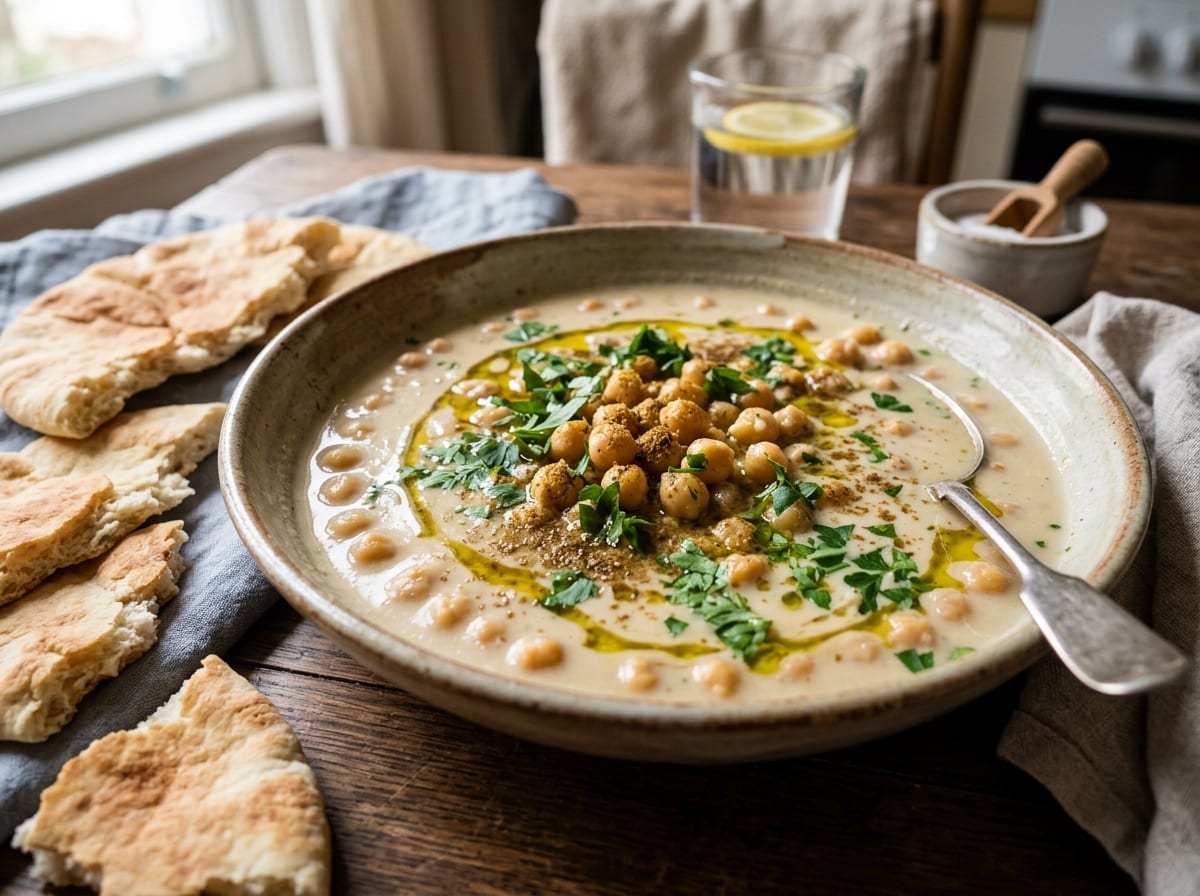
Masabacha
The other hummus, and the one served for breakfast across the Levant. The chickpeas are left whole and warm, the tahini is poured over rather than blended in, and the name means swimming, which is exactly what it looks like.
Prep15 min
Cook75 min
Rest480 min
Servings4
Levantine breakfast dish, chickpeas left whole and dressed rather than blended
Ingredients
Written for a 4 L pot
Units
Temperature
Servings
The chickpeas
- 200 g dried chickpeas rounded
- 4 g bicarbonate of soda, for the soak only, and less than the smooth version takes rounded
- 1 bay leaf rounded
The tahini sauce
- 150 g tahini rounded
- 60 ml lemon juice rounded
- 100 ml ice water, or the chickpea cooking liquid, cooled, which is better rounded
- 2 garlic cloves, crushed to a paste with salt rounded
- 7 g fine salt rounded
On top
- 40 ml olive oil rounded
- 15 g flat parsley, roughly chopped rounded
- 5 g ground cumin rounded
- to taste sumac, chilli flakes or pickled chilli rounded
Dietary labels are a guide, not a guarantee. If you have an allergy, read the ingredients yourself.
Method
- Soak the chickpeas overnight with the bicarbonate of soda, then drain.
- Simmer in fresh water with the bay leaf for 50 to 75 minutes, until soft but still whole. Keep a mugful of the cooking water.
- Make the tahini sauce while they cook. Whisk the tahini with the lemon juice and garlic paste; it will seize solid. Then whisk in the ice water or cooled cooking liquid a little at a time until it pours like cream. Salt it last.
- Drain the chickpeas but keep them hot, and stir about a third of them roughly with a fork so some break down and thicken the bowl.
- Spoon them into wide bowls, still warm, pour the tahini sauce over generously, and finish with oil, parsley, cumin and something sharp.
- Eat it immediately with bread. This is not a make-ahead dish.
How it differs from smooth hummus
Same three ingredients, opposite decisions at every step. It is worth having both, because they are not versions of one dish so much as two dishes that happen to share a pantry.
| Smooth hummus | Masabacha | |
|---|---|---|
| Chickpeas | cooked to collapse | cooked to just soft, left whole |
| Tahini | blended in | poured over |
| Temperature | room temperature | warm, and eaten straight away |
| Texture | uniform and whipped | loose, in pieces, soupy |
| Eaten as | a dip | a bowl with a spoon and bread |
| Keeps | five days | not at all |
Notes
- The name is the recipe. Masabacha comes from the Arabic for swimming. If the chickpeas are not swimming in sauce, add more sauce.
- Use the cooking liquid, not water. It is starchy and faintly savoury and it makes a rounder sauce. This is the one advantage of cooking your own that survives even a rushed version.
- The fork matters. Crushing a third of the chickpeas gives the bowl body without turning it into hummus. Do it in the bowl, roughly, and stop early.
- Warm is not optional. Cold masabacha is a bowl of dressed chickpeas, which is a perfectly nice salad and not this.
- The usual toppings are sharp, because everything else in the bowl is soft and rich. Pickled chilli, sumac, raw onion or a spoonful of the pickle jar all work.
Ingredient substitutions
- Tinned chickpeas actually work here, unlike in the smooth version, because you are not asking them to collapse. Simmer them 10 minutes in their own liquid with a bay leaf first, and use that liquid in the sauce.
- Sumac is worth seeking out and has no real substitute. Lemon zest with a pinch of salt is the nearest thing in a German supermarket.
Sources consulted
Good with
Sources consulted
From Christoph Mayer