Main Chinese restaurant-style Chinese Dairy-free Nut-free
Singapore Noodles
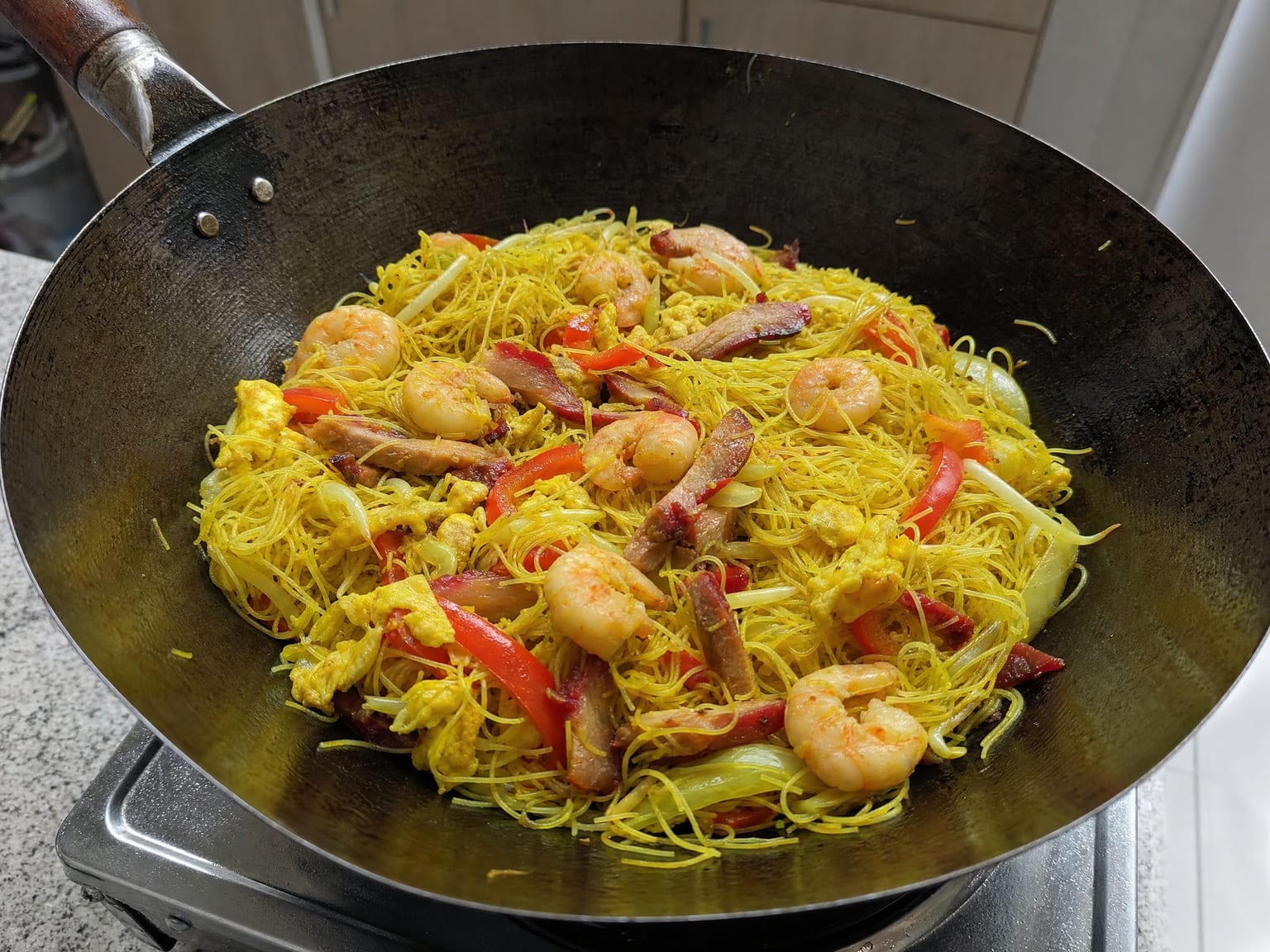
Thin rice vermicelli tossed with curry powder, prawns, char siu and egg, a dish invented in Hong Kong and named after a city it has nothing to do with. The curry powder is bloomed in oil rather than stirred in at the end, which is what turns it from a dusty yellow coating into something fragrant, and the vermicelli is soaked rather than boiled so it can absorb sauce in the wok instead of arriving already waterlogged.
Adapted from RecipeTin Eats' Singapore noodles, keeping her soak-not-boil rule for the vermicelli and the curry powder split between sauce and bloomed oil.
Ingredients
Written for a 30 cm pan
Noodles
- 200 g dried rice vermicelli, the thin ones, not glass noodles rounded
Sauce
- 45 ml light soy sauce rounded
- 45 ml Shaoxing wine rounded
- 9 g mild curry powder, Madras style; see substitutions rounded
- 5 g sugar rounded
- 2 g ground white pepper rounded
Stir-fry
- 40 ml neutral oil rounded
- 3 g mild curry powder, extra, bloomed in the oil rounded
- 2 eggs, beaten rounded
- 150 g raw prawns, peeled, small ones rounded
- 120 g char siu BBQ pork, cut into thin strips; see substitutions rounded
- 100 g onion, finely sliced rounded
- 3 garlic cloves, minced rounded
- 120 g red pepper, finely sliced rounded
- 120 g bean sprouts rounded
- 3 scallions, cut into 5 cm lengths rounded
Dietary labels are a guide, not a guarantee. If you have an allergy, read the ingredients yourself.
Method
- Soak the vermicelli, do not boil it. Cover the noodles with warm tap water and leave 10 to 15 minutes, until pliable but still firm with a slight chalky core. Drain very well and leave in the colander. Boiled vermicelli arrives at the wok already full of water and can absorb nothing.
- Mix the sauce and keep it beside the stove.
- Scramble the egg and remove it. Heat a third of the oil in a hot wok, pour in the egg, let it set, break into soft curds and tip onto a plate.
- Sear the prawns briefly in a little more oil, 60 seconds, until just opaque. Remove them too.
- Bloom the curry powder. Add the remaining oil and the extra 3 g of curry powder over medium heat and stir for 20 to 30 seconds until it smells toasty and the oil turns deep yellow. This is the step that separates fragrant Singapore noodles from a bowl of yellow dust; curry powder needs fat and heat to release.
- Fry the aromatics and vegetables. Turn the heat up, add the onion for 1 minute, then the garlic and pepper for another minute.
- Add the noodles and toss with tongs. Tip in the drained vermicelli and pour the sauce over, then lift and separate with tongs or two spatulas for about 2 minutes until every strand is evenly yellow. Rice vermicelli tangles and breaks if you stir it like pasta; lift and shake instead.
- Return everything and finish. Add the prawns, egg, char siu, bean sprouts and scallions, toss for 30 seconds off the heat and serve.
Notes
- Not from Singapore. The dish is a Hong Kong invention, and in Singapore itself it is essentially unknown. It reached Canadian and British Chinese menus through Cantonese kitchens.
- The noodles break if you fight them. Use tongs, lift from underneath, and accept that some strands will snap. Stirring with a spoon shreds them.
- Curry powder goes in twice for a reason: some in the sauce so it disperses evenly, some bloomed in oil so it smells like something. Doing it only one way gives you either flat colour or uneven patches.
- Mild curry powder, not hot. This is a Cantonese use of an Indian spice mix and it should be fragrant rather than fiery. Add chilli separately if you want heat.
- Leftovers reheat surprisingly well in a hot dry pan, better than most noodle dishes here.
Ingredient substitutions
- Curry powder should be a mild Madras-style blend, sold in every supermarket in Germany and Canada. Avoid Thai curry pastes, which are a different thing entirely and will not work here.
- Char siu can be swapped for any cooked pork, ham, or simply left out with more prawns. Char siu BBQ pork is here if you want to make it.
- Shaoxing wine substitutes with dry sherry, or stock plus a splash of rice vinegar.
Sources consulted
Good with
From Christoph Mayer